Showing posts with label Emigrating. Show all posts

Evidence of the Stories They Told and Lives Well Lived

Ralph with a model airplane, late 1940s.
In February 2021, over the course of several cold and dreary days, I gathered with SM and LM and their children at Ralph and Ella's home in Centerville, Utah. We were there to help in the continued effort to sort and find new homes for Ralph and Ella's belongings and mementos, as the family was preparing their home for sale. 

I brought my scanner as a carryon, and set up shop in Ralph and Ella's office. We organized photos and documents, and I scanned and scanned and scanned for days (and twice all night), creating digital versions of these priceless treasures, to be able to document and share these files with the broader family.


The days I spent there were so sacred, to be granted a peak into what Ralph and Ella saved, what was most important to them, what they hung on to, and what they wanted to remember. Each item made a statement about what they valued. 


But what touched my heart most was to find concrete evidence of the stories that Ralph and Ella told. The stories were already real, but these relics brought them to life.


Here are a few examples:


A range that Ralph purchased from his uncle Ray's shop, Inglish Electric. 
Paid in 30 monthly payments of $8.56.


View of Mesa, AZ, from the air, of Rendezvous Park
(coincidentally, where Ralph and Ella met)


This was labeled on the back, "My hobby."

  • The huge family tree that Kate Findlay (Ella's mother) had created. She was ahead of her time with her genealogical research! This chart starts with George and Kate Findlay (born in 1903 and 1904, respectively), going back I'm not sure how many generations, but the earliest date listed is 1080 AD. (See a video of it here.)


Kate Findlay's handwritten family tree.
For context, this chart measures about 5-feet wide and dates back to 1080 AD.


Reclining against the handle bars.

On two wheels!


  • Ella's school notebooks and study guides from Scotland, while a student at the Aberdeen Central S. S. School as an early teenager. Ella talked about how when she emigrated at age 15, she was ahead of the schooling standards for the same grade in America. But the Scots really set the bar high for their students! 

Ella's notebook for English exercises, filled with essay she wrote
on various prompts.

An essay Ella wrote about a week-long school camp to Kemnay, Scotland.
(Other stories and photos of Ella's family in Kemnay, here.)


Note how spelling and grammar were corrected, and then Ella had to 
rewrite the corrected words at the end of her essay.


Ella's English and Arithmetic exam book


"Mental Arithmetic" - I wonder whether this was a focus in the US curriculum for this age
in the late 1940s. Ella was really good at doing mathematic calculations in her head.


  • Files and files and files of family history work, for both Ella and Ralph's sides. 


Just a sampling of the many files of family history work
that Ralph and Ella saved. 


  • Sweet correspondence with loved ones far away - grandparents, cousins, friends, and even Ma Pat, the sweet woman who lived upstairs from the Findlays on Prospect Terrace in Aberdeen, and who assisted in Ella's birth.


A letter from Ma Pat to Ella, 15 January 1952

  • Every card, note, photo - it seems like that they ever received - saved in shoeboxes and plastic bins. Including children's art projects, letters to Santa, notes from children, grandchildren, and great grandchildren.


A note to the Easter Bunny,
from Ralph and Ella's daughter BR.


These, and many more artifacts, are physical testaments -- evidence of the stories they told and lives well lived. (May I live my life as well, and with the evidence to show for it.)


Come, Come, Ye Saints

A wallhanging quilt I made for the
sesquicentennial (150 years) celebration
of the Mormon pioneers first arriving in the
Salt Lake valley in 1847 (the top corner
squares). Also a tribute to Ella's family who
emigrated from Scotland to America in 1949
(the bottom corner squares). 
(Click to enlarge.)

When we talk about pioneers, we typically think of covered wagons and handcarts and trekking west across the American frontier. But I think of Ella and her parents, pioneers who left their homeland and family to settle in an unknown-to-them territory. 


Ella LOVED Pioneer Day, July 24, which commemorates the arrival of the first Mormon pioneers to the Salt Lake Valley in 1847. Her love for pioneers started in her youth, as her family would gather together around their piano and sing Come, Come, Ye Saints, and they would hope, and dream, and plan for the day when they would join with other members of their faith in America. 


Here are some thoughts that Ella shared in a talk she gave to her church congregation in Long Beach, California, in the 1960s. See the full scan of her original talk, below. 


..........


My parents joined the church before I was born and I think the missionaries must have had a tough time with them as it took them a year before they accepted the gospel and were ready for baptism.


At that time it was the hopes and goals of all [Latter-day] Saints to emigrate to Zion and so my parents started saving and in 1939 the ball got rolling for us to come to this country. But as you know the world was very unsettled at that time and Britain declared war in September of 1939, and our hopes were dashed. One of the missionaries who helped convert my parents was to be our sponsor and he offered to take care of my sister and I until our parents could join us after the war -- as they had Red Cross ships sailing to America with children, but my parents declined the offer and I am so happy about that as I was only 5 years old at the time and I wouldn't have remembered Scotland or appreciated it as I do today. 


Once war was declared all missionaries were called home. My father was made Branch President and during all of the war we only had two active families, [but] we held Sacrament meeting every Sunday evening and my father and the other Priesthood holder would take turns conducting, blessing and passing of the Sacrament and giving talks. 


We feel that we were blessed greatly, because although bombs dropped close to us and bullets hit our house no harm came to us or the other members of the branch. My father worked in the shipyards and had many close call[s] both from bombs and having to come off the ships and ride his bicycle home often late at night in complete darkness as we had total blackouts, and in Scotland the nights in the wintertime are very, very dark. But as a child I can truthfully say that I felt my parents trust in the Lord and never felt fear and knew that we were in His keeping. 


During the latter part of the war my mother started working diligently on her genealogy and was able to collect a great deal of names and was able to even get into [m]onasteries where a great deal of records are kept and [up to] that time had been inaccessible. So having to stay behind in 1939 had indeed been in blessing in disguise. 


...


The years went by and our thought once again turned to Zion. My mother played the piano and her favorite [song] was Come, Come, Ye Saints --- and she would gather us around the piano and say, "[Come on learn this son[g] as we can't go to America if we aren't able to sing this.["] I guess she thought it was a [p]assword to get in, but sincerely it is a very special song for me, although my parents were not early pioneers, they did have to give up everything they had to come to this country and start [over] which isn't exactly the easiest task when you're in your forties. 


So in 1949 our plans gelled once again, many letters were sent back and forth. Our visas and passports were procured after having medicals and interviews with the American Consul. 


On Friday, May 13, 1949, we sailed from our homeland and loved ones to a new Frontier. [A] land full of dreams and expectations, and we were not disappointed as life had been good to us and my parents have been repaid many times over for their faith in the Lord. 


I want to say how thankful I am for the missionaries who brought the Gospel to my parents and how doubly thankful I am that I can claim a double heritage, Scottish by birth and American by choice. Brothers and Sisters let us be thankful for this promised land and for our precious freedom that we can worship and live as we choose. 


..........

(Click to enlarge.)

(Click to enlarge.)

(Click to enlarge.)

(Click to enlarge.)

(Click to enlarge.)

(Click to enlarge.)

..........


Although I have grown up as and am an actively practicing Mormon, I am in awe, and humbled, by the sacrifices our ancestors made, to more fully live what they believe. 


Selling virtually all that they owned and traveling essentially with the clothes on their back, they waved goodbye to family as they boarded the train that took them to the ship harbor. Grandma was now 15 years old. The journey was so expensive and they had saved for so many years, they didn’t know if they’d ever return to their homeland. These were one-way tickets. 


America didn’t necessarily offer them greener pastures, either literally (they settled in Arizona, after all) or figuratively: It’s no small task to start a new life from scratch. And they were sometimes ridiculed for their accent, and treated as second class citizens. 


Why did they do all this? I think about this often. The conclusion that I’ve come to is that I believe they had a vision of the future, of how their sacrifices would benefit generations to come. We are now standing on their shoulders.


We have that same blood coursing through our veins. And we can tap into that same strength and determination. We too can trust in God, and that he has a plan for our lives and he will direct us as we seek to know that plan. We can have courage in the face of hardships, as we ourselves face oceans and continents that separate us from our final destinations, and as we may sometimes find ourselves as strangers in a strange land. 


We too can do great things, GREAT THINGS, that will influence, for good, generations to come. 


..........

See also these related posts:

Ina Findlay Slade's Memories of Aberdeen and the Church during WWII

Ina Findlay, Betty Sutherland, 
Helen Edwards (or Helen
then Betty?), and Kate Findlay
The following is a memory posted to the page for Charlesina Findlay Slade (1928-2015) on FamilySearch, written by Charlesina herself. Charlesina, most often called Ina, is Ella's sister.


See also these previous, related posts:


..........

When I was 11 years old, there was excitement in our branch in Aberdeen, Scotland. It was September 1939 and the Millennial Chorus was in Aberdeen for one week. This chorus was made up of missionaries touring the mission, giving concerts.


At this time, 1939, the Aberdeen Branch was the northernmost branch in the British Mission. It was exciting to an 11 year old to be around that many missionaries at one time. They had concerts booked all week and at the end of the week there was to be a special treat. The mission president, Hugh B. Brown, would also be in Aberdeen. A room in the Music Hall had been reserved and President Brown would speak and the Millennial Chorus sing. But, alas, events in Europe were to interfere with these plans. September 3, 1939, Britain declared war on Germany. This meant Pres. Brown could not leave London. Plans and preparations had to be made for all missionaries to leave Britain and return to the U.S. This was a sad time. The chorus was advised by President Brown to finish their appointments, and go ahead and give the concert at the Music Hall. Since Pres. Brown would not be there, they had to fill in that time and sing twice as long, then they were to report to London. The withdrawal of the missionaries brought changes in the leadership of some of the branches. My father was made Branch President and mother the Relief Society President. It was a small branch to begin with, but with the withdrawal of the missionaries, this was a test of the faith of the members, and many fell away. During the six years of war, Aberdeen, one of the four branches in Scotland, was the only branch to remain open all through the war years, with only eleven of us usually in attendance at meetings; 5 adults and 6 children. One family evacuated to the country to get away from the air raids. Aberdeen is on the northeast coast of Scotland on the same latitude as southern Norway. The German planes had but a short hop, skip and jump from Norway to Aberdeen, and it was easy to find as it stood between two rivers. Radar had not been perfected yet and as a result, the German planes could sneak in and drop their bombs before the air raid siren blew. It was very frightening, hearing the thud of the bombs, and wondering where the next one would land. During the worst raid, a bomb was dropped just two streets away from where we lived. One member had her apartment damaged in one raid. The members did not have telephones, so Mother, as Relief Society president, had to rely on inspiration to know which sister she needed to visit. One morning after one raid, she felt the need to check on Sister Hendry. When she got to her street, it was blocked and a policeman on guard said a bomb had dropped there. The people had been taken to a Red Cross facility, and Mother found her. She was able to stay temporarily with another member until other arrangements could be made. With only six children in the branch, it was difficult to have Primary or Mutual. The missionaries had been led to my parents in 1930, but it was two years before they were baptized in the River Dee. I was only four years old then but my sister and myself were also baptized in the River Dee a few years later. The baptisms took place at a secluded place along the river. It was not until 1948 that Father came to Arizona and the rest of us in 1949. The faith and testimony of the adults in the branch showed us the way and kept us straight. Those members were: My parents, George and Katherine Findlay Brother Smart Sisters Eliza Edwards and Mary Hendry (the children) Betty Sutherland Houston Ronald Sutherland Helen Sutherland Helen Edwards Ella Findlay Mitchell Ina Findlay Slade To all of them I will be eternally grateful for faith in every footstep.

The Day Ella's Family Was Sealed in the Temple

Vintage Postcard of the Mesa Arizona Temple
Source: Postcard Bought on eBay
After converting to The Church of Jesus Christ of Latter-day Saints in June 1932, Ella’s parents, George and Kate Findlay, started making plans to emigrate to America. They would leave their homeland, their family, friends, occupations, and the comfort of a communal culture...to buy one-way tickets on an ocean liner.

It wasn’t fame or fortune that called to them, but the desire to gather together “in Zion” with other members of the Church and to receive the blessings of the temple. At that time, the only operating temples of the Church were in the United States and Canada, and there weren’t any announced plans to build any others in Europe anytime soon.(1) If families wanted to receive these saving ordinances and be sealed together, they made the sacrifice to emigrate.

Mesa, Arizona, would be their final destination, with the family coming in waves: First George in December 1948, then Kate and Ella in May 1949, and Ina following a few months later in October 1949. (Read more about their emigration story here and here.)

The Mesa temple was just a few blocks from their home. And the day for them to be sealed together as a family had finally arrived, in spring 1950.(2)

Ella was 16 at the time. And unfortunately, when I finally thought to ask Ella about details of the day, she couldn't remember much. However, when we visited Ralph's first cousin MJ in October 2018, MJ shared what she happened to remember about that day - it made such an impression, recalling it almost 70 year later. How is this relevant? MJ, although a cousin of Ralph's, she was also a classmate and friend of Ella's.

MJ recalled (3):
We were friends in high school, and I remember the day they were all going to be sealed. And they were looking forward to that day....And then they had a dance that night; it was a big party. It was like the Gold and Green Ball. And I remember you [Ella] said to me, "But isn't being sealed together such a sacred thing that would we want to end the day joyfully and jolly, you know, going to a dance?" And I thought, Wow! This girl is just golden! I mean, I was so impressed with that because the sacredness of finally having your family sealed together and you didn't want the day to end partying, you know, or taking away from that sacred [experience].
This girl certainly is "just golden"!
Ralph's cousin MJ, who was also a classmate of Ella's, recalls when Ella's family
was sealed in the temple. Filmed 26 October 2018.
1:03 min


Notes:
  1. The first LDS temple in Europe (and 9th operating LDS temple) was built in 1955, in Bern Switzerland. Source: http://www.ldschurchtemples.com/chronological/
  2. I'm still trying to track down the exact details, but it looks like George and Kate were sealed together on 7 February 1950, while Ina was sealed to them on 31 March 1950. If Ella was sealed to them on either of these, or another day close to this time, she would have been 16 at the time.
  3. From a visit on 26 October 2018.

Ella Becomes a US Citizen

“Scottish by birth, American by adoption, and humbly grateful for both.” This is what Grandma Ella often says. She is undoubtedly proud of her native heritage, but it’s also arguable that she’s one of the most patriotic “adopted” Americans around!

On 3 May 1957, Ella petitioned to become a naturalized citizen of the United States, and on 14 June 1957 she officially became one. 

In honor of America’s Independence Day on July 4th, I wanted to share some of the requirements to become a US citizen. It’s a big deal to change your citizenship! But I love Ella’s philosophy - to celebrate both nationalities and to be “humbly grateful for both.”


Ella's US Naturalization Record
What does it take to become an American citizen? The requirements might have been slightly different in 1957, but today it includes the following:(1)

For an adult immigrant to become  a U.S. citizen, he or she must go through the process of naturalization. GENERAL requirements for naturalization call for the immigrant to:
  • Be at least 18 years old at the time of filing the Application for Naturalization, Form N-400 
  • Be lawfully admitted permanent resident of the United States 
  • At the time of the filing the application, have been a permanent resident in the United States for at least for five years OR for at least three years if you meet all eligibility requirements to file as a spouse of a United States citizen
  • Have demonstrated continuous permanent residence 
  • Have demonstrated physical presence 
  • Have lived within the State or United States Citizenship and Immigration Services District for at least three months prior to filing 
  • Have demonstrated good moral character 
  • Demonstrate an attachment to the principles and ideals of the U.S. Constitution 
  • Demonstrate an ability to read, write, speak and understand basic English 
  • Demonstrate a basic knowledge of  U.S. history, government, and civic principles 
  • Take an oath of allegiance to the United States 
  • Receive a Certificate of Naturalization

You are not a U.S. citizen until you take the Oath of Allegiance at a naturalization ceremony.(2)
I hereby declare, on oath, that I absolutely and entirely renounce and abjure all allegiance and fidelity to any foreign prince, potentate, state, or sovereignty, of whom or which I have heretofore been a subject or citizen; that I will support and defend the Constitution and laws of the United States of America against all enemies, foreign and domestic; that I will bear true faith and allegiance to the same; that I will bear arms on behalf of the United States when required by the law; that I will perform noncombatant service in the Armed Forces of the United States when required by the law; that I will perform work of national importance under civilian direction when required by the law; and that I take this obligation freely, without any mental reservation or purpose of evasion; so help me God.
.......... 
Notes & Sources:
  1. Source: https://www.usa.gov/become-us-citizen
  2. Source: https://www.uscis.gov/us-citizenship/naturalization-test/naturalization-oath-allegiance-united-states-america

George and Kate Findlay Meet the Mormons

How were George and Kate Findlay first introduced to the Mormon church? That was such a pivotal moment that would lead to their conversion and forever change the course of their lives. But it was a detail that remained a mystery to many of their descendents until this past July, when cousin ES (a great grandson of George and Kate) shared a scanned copy of the Life History of George and Katherine Findlay. This is their life history as Kate told to her grandson NS, who recorded it on tapes and it was later transcribed. Thank you to the various S Family members who worked to preserve these details!

The information below is an excerpt from that history. The formatting has been adjusted slightly to improve readability, and minor clarifications have been added in brackets. 

If you have additional details to add or any clarifications to make, please do! Send that to me via the "Contact Form" at the bottom of this page.
..........

We got married in 1927 and in 1930 we thought we would like to have a holiday. I wrote to a friend of my mother’s from Shetland, a Mrs. Smith. She lived in Leith [just north of Edinburgh]. She wrote back and said they had a room. I had said to ask for bed and breakfast because then we could go out and just come back anytime. This woman, Mrs. Smith, when we went to the address there was a note on the door that said, very sorry but have been sent for to go to Shetland because my mother is very ill. Go to Mrs. [Agnes] Jamieson who lives next door and she will take you.

We went there and she was a nice lady and I know she was from Shetland from the way she spoke. Next morning at breakfast she said to me, “Mrs. Findlay, are you a Bruce?” I said, “Well my mother was a Bruce and Bruce is in my name.” She said, “I thought so. Was your mother(1) born in Burravoe?” I said she was. “Well”, she said, “My father was bailiff to your mother’s mother and father.” A bailiff is like a manager to an estate.

Now my mother had told me things about the place and she had said they had been a well-known family and had money, but it went in here and out there because I didn’t know if it was true or not. I have faint recollections of being in Shetland. She took me there and I did know that I was in a big house. This woman said my mother was telling the truth. She said, “If you look out my window (and she lifted the window) and if you look out from here down to there (and this was the end of the street). That is the length of the banqueting hall.” I was quite surprised.

The Manor House in Burravoe, Yell, Shetland, where Kate's mother Ursilla
Katherine Bruce was born - Photo taken Sept 2014
Then she says, “Oh but you know you had relatives that came to see me.” I said, “Relatives! I havena got such a thing. I’m an only child and mother’s two brothers died. I don’t have any relatives.”

She said, “Oh, but you do. They are from America. These two fellas that came to the door and one of them was looking for me," said Mrs. Jamieson. The family in America, they knew her name and where she lived because the station her father had, had been manager, and she said these fellas want very much to get in touch with your mother. I thought, “That’s strange. I can’t understand that because she has no relatives in America. She has an uncle in Australia but he would be dead now and he made money in beer. He built a big factory and was a millionaire."

She said, “But you do have relatives in America.” She described him and he was a very nice clean living boy and there is one thing I have to tell you. They were Mormons.(2)

George and me nearly had a fit because you know Mormons were something terrible and I was afraid of them. They would be back but they hadn’t been yet. I left my address and said I would be glad to see them.

That was July and we were on holiday in Edinburgh and when we went back I spoke to my mother about it, and she said yes, she knew Mrs. Jamieson, and I asked about this family in America. She thought a minute and said she knew.

Her aunt Mary Bruce married a Scott Anderson and they became Mormons and had five children. And he was a lawyer and left from Liverpool to go to Salt Lake City. And they were never heard from again.

Scott and Mary Bruce Anderson. Image source: Family Search

Elder William S. Costley was the first
missionary to contact George and Kate
Findlay in Aberdeen in October 1930.
Image Source: Life History of George
and Katherine Findlay
That was July and in October a knock comes to the door and it was this young fella in a black suit and he offered me a pamphlet. I took it and he represented The Church of Jesus Christ of Latter-day Saints. I said I had never heard of it and he said it was better known as the Mormons. From there on the missionaries came and I was ready for them. That missionary lived in Ogden and his name was Elder Costley.(3)

At that time one missionary went down one side of the street and the other missionary went down the other side. He said his companion was across the street and could they come and visit and they would tell more about the gospel. I thinks to myself - Mormons - they can’t come here. But I said, well come on Saturday and from then on the elders came.

Well to finish the story about Mary and Scott Anderson. Every different elder that came I asked to try and find them but it seemed that there were lots of Andersons in Salt Lake City. Two years passed and then we joined the church. I was ready to join in a year but I waited for George.

Kate was baptized on 11 June 1932 by branch president Le Grand Gentry Sharp and confirmed on 12 June 1932 by missionary Elder Carl Condie.(4) George was baptized on 13 June 1932.(5)

Certificate of Baptism for Ursula Katherine Bruce Findlay, 11-12 June 1932
Source: Life History of George and Katherine Findlay
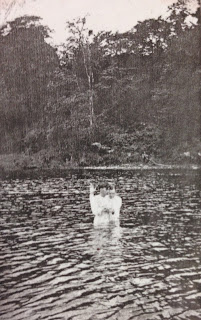
Baptism of George Findlay in the
River Dee - 13 June 1932

The following year after we were baptized, Patriarch [James H. Wallis], the only patriarch that had ever been to Scotland, came and it was announced that we could have a patriarchal blessing. None of us had ever heard of patriarchal blessings and we didn’t know what it was. They said to put your name in if you were in good standing and you would have to go to Glasgow where they were having conference.

We decided we couldn’t ask for a blessing because we had only been members for a year. The elders came on Saturday and said they hadn’t heard from Brother Findlay that we wanted a blessing. George said he didn’t know what a blessing was and anyway they had only been members a year. They told him what it was and said it didn’t matter how long you had been in the church and they had been praying about it because they felt and were very sure, that someday you will be very needful of this blessing, and this blessing will really help you.

So we went to Glasgow and got a blessing [on 11 June 1933, by Patriarch James H. Wallis]. This was years before the war but the elder had been inspired to say this.

President [John A.] Widtsoe, who was president of the mission(6), and the president(7), and patriarch [Wallis] were going up to Wick. President [David O.] McKay(8) asked them to please go and visit and tell him how the people were. So they went to Wick and they sent word to Aberdeen to tell them to have a meeting and gather their friends. Of course the elders were busy and I was busy trying to get people to come to the meeting.

It was a very small branch of regular members - there might have been 12. But there were others who had heard of us and we went to them. There were about 30 or 40. They were on the stage and some of the elders were with them and every time I lifted my head I could see this patriarch. He was an old man at the time. I have a picture of them.

The Aberdeen Branch at a picnic social. George and Kate's daughters,
Ella and Ina, are in the front row on the far left. Date?
He looked at me quite a lot and I said to myself, what have I done? I kind of got scared. They announced after the meeting that President (9) would like to go around and shake hands with everybody and talk to them and get a general idea of who people were.

He went around the room and every time I saw him getting closer I moved. I did speak to President Widtsoe, and this patriarch [Wallis] eventually caught me (10) and he said, “What’s troubling you? Are you a member of the church?” I said, “Oh yes, I’m a member of the church and I believe the church and the gospel.” He asked what was troubling me. I said, “I’m searching for people in Salt Lake City and I can’t find them. Every elder goes and tries to find them. If I can find them I can get my start in my genealogical work.” He said, “Tell me who they are.” And I told him about Scott Anderson and Mary Bruce and she was my mother’s aunt from Shetland.

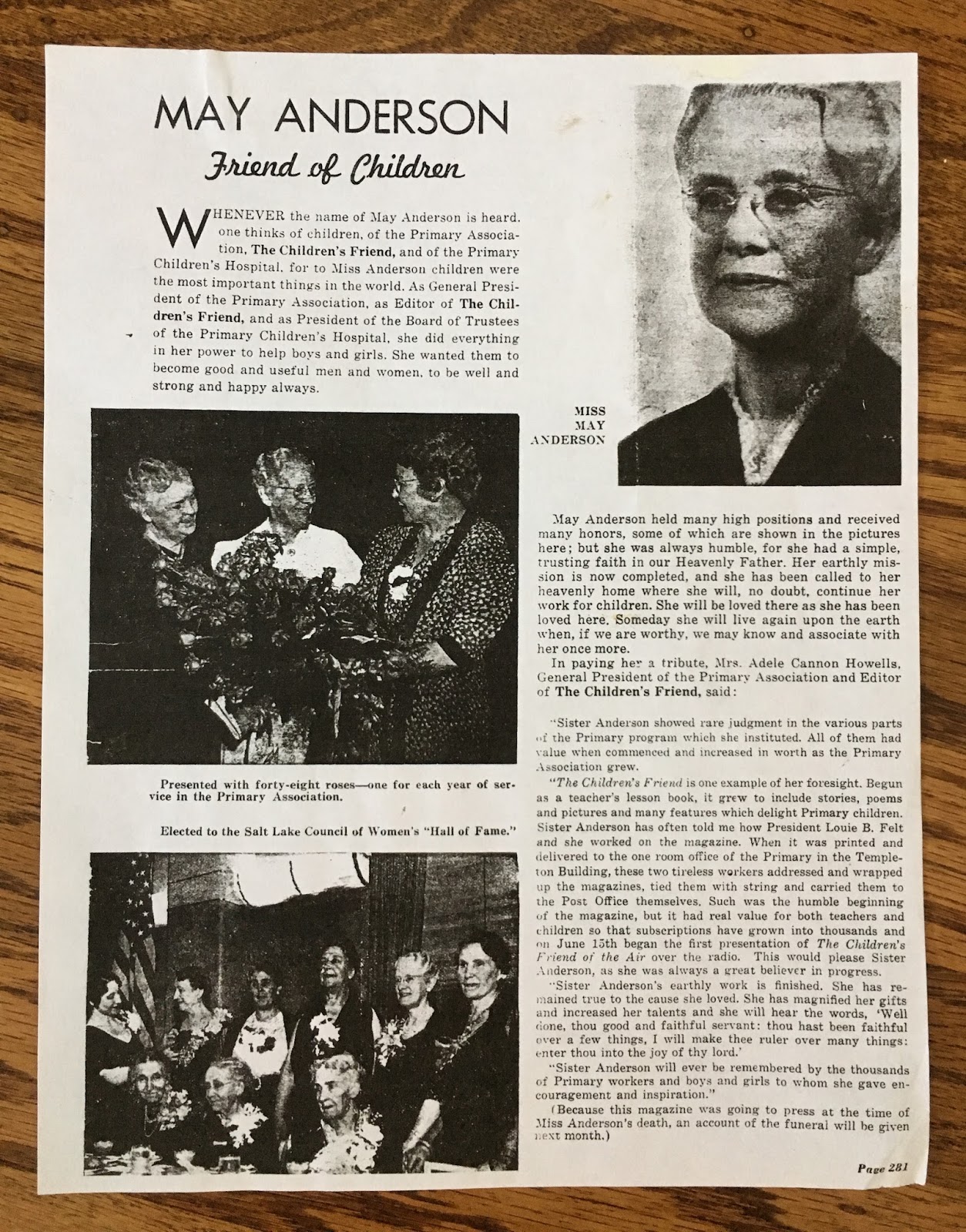
A smile came across his face and [he] put his arms around me and said there are six sons and three daughters. … Three daughters Elizabeth, May, and Kate. ... Then he asked me if I got the Children’s Friend [magazine], and I said the elders were very kind and have given it to me. Well, he said, have you seen a picture of a lady in there, May Anderson? Well, that is the daughter.”

May Anderson was a [first cousin once removed] to me.(11) She edited the magazine and also later
May Anderson, first cousin once removed
to Kate Findlay. Image Source
on she was the one proposed getting a children’s hospital and was in charge of the secretarial work in getting the money to build the hospital and I have the big bit with her picture that was in the paper after she died.(12)

He said she was a very good friend, and I’m going to write to her tonight. He gave me her address and asked me to write. She got my letter the same time she got his and I got a letter back and from then on it was a bit easier but I still had a lot of struggle to get this first start in genealogical work.

……….
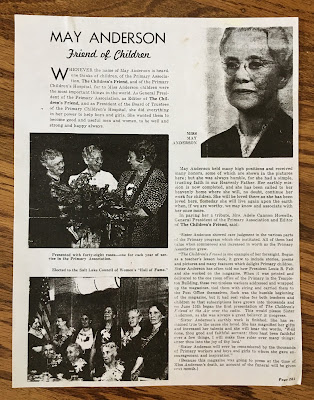
Perhaps this is the same "big bit"/article that
Kate referred to. Grandma Ella shared this copy with KF.
Click to enlarge.
I wonder to what extent Kate Findlay and May Anderson then kept in touch. Unfortunately, May passed away in 1946, 2-3 years before the Findlays emigrated, so they never had the chance to meet in person.

But when the time came for Kate and daughter Ella to emigrate in May 1949(12), they were in contact with other American cousins from the Anderson family, also members of the church. As they crossed the US by train from New York to Salt Lake City, before they boarded a bus to Arizona, they were hosted for a few days in Salt Lake by Kate's second cousin: Louise Undine Loftus Anderson Clark. She was the daughter of Scott W. Anderson (May Anderson's brother) and Mary Ann Loftus.

In March of this year, I got in touch through Family Search with a grandson of Undine Clark: HC in Texas. I was curious to learn about how his branch of the Bruce line (his ancestors Mary Bruce and Scott Anderson from Shetland) had been introduced to the church and emigrated to Salt Lake City.(13) I was also wondering how Kate would have been in touch with these cousins across oceans and continents. At the time I was merely curious but hadn't yet received the Life History of George and Katherine Findlay (that would come in July), so I didn't know the details of Mrs. Jamieson in Leith first telling Kate of her American cousins.

Cousin HC replied in an email to me: I remember as a boy hearing her talk about the time her relatives came to see her on their way from Scotland to Arizona. I don't remember her saying they were LDS but she so loved seeing them she talked about it for years. That must have been your grandmother. Tell her Undine often talked lovingly about that visit from the "old country" to her grandchildren. She told me she made rack of lamb with mint jelly!

This past July, as we were in Utah on vacation, we visited the graves of Mary Bruce and Scott Anderson and their daughter May Anderson at the Salt Lake City Cemetery. I took a moment to tell them thanks - thanks for looking out for their cousins from the "old country" and  for helping to forever change the course of our lives.


Photos taken of the Anderson family graves in the
Salt Lake City Cemetery - July 2017
How is Kate Findlay related to these American cousins? See above.
Click to enlarge.

Also see these related posts:

Notes:
  1. Kate Findlay's full name was Ursula Katherine Bruce Findlay (pronounced ER-sill-a). Her mother was Ursilla Katherine Bruce Beattie (pronounced yer-SILL-a).
  2. If I’m understanding correctly, two Mormon missionaries knocked on Mrs. Jamieson’s door in Leith, having heard of Mrs. Jamieson's family and her bailiff father, and also wanting to get in touch with Kate's mother, Ursilla Katherine Bruce Beattie...Is that correct? Then, was one of those missionaries a cousin? Based on the timeframe, could that elder have been of the grandchildren of Mary Bruce and Scott Anderson?
  3. Elder William Sycivell Costley served in the British Mission from June 1929 to August 1931. Source: https://history.lds.org/missionary/individual/william-sycivell-costley-1910?lang=eng.
  4. Elder Carl Condie served in the British Mission from June 1930 to September 1932. Source: https://history.lds.org/missionary/individual/carl-condie-1909?lang=eng.
  5. Does anyone know who baptized and confirmed George? Does anyone have a copy of or the original baptismal certificate?
  6.  John A. Widtsoe was actually president of the British Mission just prior to this, from November 1927 to December 1928. Source: https://history.lds.org/missionary/individual/john-andreas-widtsoe-1872?lang=eng] James Henry Douglass, would have been the mission president at this time, who served from December 1931 to January 1935. Source: https://history.lds.org/missionary/individual/james-henry-douglas-1858?lang=eng]
  7. Is it clear which president this is referring to?
  8. I'm not sure what David O. McKay's church calling was in 1933 as he was previously president of the European Mission (1923-1925) and had not yet served as a counselor in the First Presidency (1934-1951) and this was years before he would be ordained President of the church (1951). However, he would have had the title of "president" in all of these positions. Source: https://en.wikipedia.org/wiki/David_O._McKay#Member_of_the_Quorum_of_the_Twelve
  9. Would this have been the mission president?
  10. I wonder whether Kate got the order of events slightly mixed up. Would she have first met Patriarch Wallis at the conference, when he asked her "What's troubling you?", and later given her the patriarchal blessing? As it's written, she received her blessing from Patriarch Wallis but then it sounds like they met for the first time afterward. It's a minor detail that does not affect the ending of the story.
  11. Kate Findlay had recorded that she was second cousins to May Anderson, but she was actually a first cousin once removed as Kate's mother, Ursilla Katherine Bruce was first cousins with May.
  12. May Anderson was the editor-in-chief of The Children’s Friend magazine from its inception in 1902, and she served as the first counselor to general Primary president Louie B. Felt from 1905 to 1925, then served as the second general president of the Primary from 1925-1939. Sources: https://history.lds.org/media/may-andersonlg?lang=eng#1; https://en.wikipedia.org/wiki/
  13. George had emigrated to the United States previously, in December 1948. Kate and younger daughter Ella followed in May 1949 while their older daughter Ina arrived in October 1949. 
  14. Cousin HC is working on compiling memories and information about his ancestors' conversion, Mary Bruce and Scott Anderson. As he prepares details, I hope to share relevant information on this blog.