Showing posts with label John McDonald Beattie. Show all posts

Meet Elizabeth Beattie (1840-1869)

This post began as a summary of the cemeteries in Aberdeen where all of our kindred are buried, with the goal of visiting their graves on our next trip (date TBD), but I’ve gotten a little sidetracked as some details were “unearthed” (for lack of a better word), with regard to Ella’s great grandmother Elizabeth Beattie and Elizabeth’s parents Adam Beattie and Janet Petrie Beattie (Ella’s great, great grandparents). Specifically, we learned more about the circumstances of their burial which gives us more insight into their lives. As I’m trying to organize the details I’ve found, howsabout we get to know Elizabeth and her family a little better. I think you’ll be glad you did!


Elizabeth Beattie is Ella's Great Grandmother

Elizabeth Beattie was born about 1840 (1) in Aberdeen, Scotland, the 2nd or 3rd of 5 children of Adam Beattie (a labourer) and Janet Petrie (unknown occupation). From the information we currently have, it’s unclear how many of those children lived to adulthood, but at least three (2): Elizabeth, her sister Janet (lived to at least early 20s)(3), and her youngest brother George.

Elizabeth worked as a flax mill worker (the flax mills processed flax, spinning yarn for the linen industry) and a flax slubber (an operator of machinery that prepares flax for spinning) (4) and perhaps also as a domestic servant. (5)

An example of a Scottish linen mill, this is Hillbank Works in Dundee
(Year? - Image Source)

At 20 years old, Elizabeth gave birth to her only child, John McDonald Beattie, born 12 November 1860. She was not married to the father, John McDonald (a boilermaker, according to son John’s corrected birth entry; an iron driller, according to son John’s marriage record). 

Kate Findlay (Ella’s mother), recorded the following about Elizabeth in her life history (Elizabeth was Kate’s paternal grandmother, and John her father). This information would have been passed down to Kate orally. (I’ve added clarifying details in brackets.)

My father [John McDonald Beattie] was born in Aberdeen, Scotland, of humble parentage. His mother [Elizabeth Beattie] was not married and had to work for her living at a [j]ute works [flax mill]. Her folks [Adam and Janet Petrie Beattie] looked after the baby while she was at work.

His mother [Elizabeth Beattie] had gone with this man [John McDonald] and she became pregnant and then she found out he was a married man. He came from Grantown and that’s down by Leith. He must have been doing a job up there in Aberdeen. She proved it [her son’s parentage] through the courts.
Ella would point out that Elizabeth was smart to use the father’s surname (McDonald) as her child’s middle name, with the mother’s surname (Beattie) as his last name, as young John was an illegitimate child and the father was actually not initially listed on the birth record. In fact, in January 1864, a little over 3 years after John was born, Elizabeth had the birth entry corrected to state that the father was John McDonald. The amended entry reads:
In an action relating to the paternity of a child named John McDonald Beattie born on or about 31 October 1860, at the instance [should this be insistence?] of Poor Elizabeth Beattie, Millworker, No. 37 St. Andrew Street, Aberdeen, against John McDonald, Boilermaker, Kirkpatricksland, [can’t decipher?] Street, Newhaven, the Sheriff Court of Edinburghshire on the 10th of December 1863, found that the said child was the illegitimate child of the parties aforesaid.
It’s not clear exactly what transpired to have the birth record amended, but it looks like it might have
involved Elizabeth traveling to Edinburgh and working with the Sheriff Court there, and then working with the registrar in Aberdeen, and it was probably still not as straightforward as that. But it sure seems that Elizabeth had guts! (And I’m shocked they felt to record Elizabeth as “poor” in this official record.) I’m grateful for her perseverance and insistence, that she went through that effort to have the record amended, as it provides us with more pieces to our genealogical puzzle. (6)

(See John's original birth recored from 1860 here; and the revised record from 1864 here.)

According to Kate’s life history, “[Elizabeth's] folks [Adam and Janet Petrie Beattie] looked after the baby while she was at work.” This seems to make sense as the census records I’ve found have not listed mother Janet as having a profession - perhaps she was taking care of little John.

It appears that Elizabeth and her son John, as well as her other two siblings, lived with her parents, Adam and Janet, in their young adulthood: In the 1861 census, the children Janet, George, and Elizabeth with son John, are listed in the household, living at 59 Woolmanhill, Aberdeen (though curiously, Adam was not listed on this census).(7) By 1864, Elizabeth with son John were living at 37 St. Andrew Street, Aberdeen (according to the corrected birth entry for son John). They would live here, with father Adam and mother Janet until they passed away in 1869 (according to each of their death records).

When Elizabeth’s son John was about 9 years old, he suffered an accident at home that caused him to be deaf the remainder of his life. The specific details are unclear, but here is what Kate recorded in her life history:

This was a turning point in his life as one day while playing near the fire in the kitchen a large pot, which was hanging [with chains] over the fire with boiling water in it, fell on him and the shock took away his hearing also speech…I don’t know if it was the pot or the water that struck him. He didn’t have any marks on his face but he was totally deaf…. 

But my father, after his accident, his mother was a [flax] mill worker, and I suppose she couldn’t look after him but she could have done better than she did….The family being poor could not look after him or educate him as they put him into a school for the deaf. But in doing so they seem to have deserted him completely as from that day till he was sixteen years of age they never visited him. So in his pride he in turn did not go visit them the remainder of his life.

It seems that John was put in the school for the deaf soon after his accident (we know he was admitted on November 28, 1870)(8)- I imagine it was a really hard decision for Elizabeth, but she was trying to make the best decisions for their circumstances.

When Elizabeth was 29, the hardships for the family increased, as her father Adam passed away on 25 March 1869 from bronchitis. He passed away at their home at 37 St. Andrew Street, Aberdeen.

Just over 3 months later, Elizabeth suffered from typhus, likely contracted from the fleas or lice so prevalent in the living conditions at the time. Per the death register, she was sick for 14 days before passing away on 7 July 1869 at the Royal Infirmary of Aberdeen, which at the time was at Woolmanhill (9). She was buried on 9 July 1869 at John Knox Churchyard.

Sadly Elizabeth's mother Janet passed away about 3 1/2 months later, on 26 October 1869 of bronchitis and "disease of heart" at their home at 37 St. Andrew Street, Aberdeen.(10)

Elizabeth and her parents Adam and Janet are all buried in the same plot, grave 58, in John Knox Churchyard, located about 1/2 mile from their home.
..........

I wonder whether Elizabeth's son John was aware of the passing of his mother and grandparents soon after he was at the school for the deaf (before he turned 10), as he seems to have grown up feeling that his family had deserted him – but in reality his mother and both grandparents had all passed away within 7 months time. His uncle George and aunt Janet seem to have survived, but it's not clear that they had any contact with John.

Royal Infirmary at Woolmanhill (Image Source)
..........

In March 2020, I reached out to the archives department of NHS Grampian, and the very helpful archivist shared with me a scan of the infirmary admission register for Elizabeth. (I'm still surprised they keep such records for so long!) It looks as though Elizabeth was initially admitted for a fever, then by the time of death it must have been diagnosed as typhus. The archivist also shared:

In order to be admitted into the Infirmary, a patient had to be recommended by someone – in Elizabeth’s case, this was the Inspector of the Poor for the City Parish, D McLeod.
Date of Admission: 28 June 1869; Admission #: 1060; Name: Elizabeth Beattie; Age: 29; Marital Status: Single; Occupation: Pauper, City; Address: 37 St. Andrew St
Recommender: D. McLeod; Ward: "Rachel"; Medical Attendant: Beveridge; Disease: Fever;
Result: Dead, 7 July; Parish: Town (Aberdeen centre)

And in June 2017, I also found this piece to the puzzle: I confirmed through the site DeceasedOnline.com what Ella had once told me, that she thought these ancestors were buried in John Knox Churchyard. Indeed, I found scans of the burial registers proving this information, and Elizabeth and her parents were all buried in the same plot, grave 58. (Note that Elizabeth is recorded as “Elis”).


Scan of burial ledger for John Knox Churchyard. See the third name down: Elis Beattie.
Access the full scan here.

Though I have not yet been to this cemetery, from looking online, it appears fairly small (unlike Allenvale!). But even though it’s small, I figured it would be best to reach out to the Bereavement Services division of Aberdeen City (which I did in January 2020) to see if they could provide a map of the cemetery, planning for that someday trip when we would visit in person.

Also, other than the cemetery register, I hadn’t been able to find any information online to confirm their burial there. Is their plot unmarked? If so, it wouldn’t have surprised me as Elizabeth and her two parents died within 7 months of each other, and Elizabeth’s son John was at a boarding school for the deaf, which implies there was no other family to assist. (And I was ready to roll up my sleeves to research getting a grave marker in place for them, as we did in 2018 for other ancestors.)

John Knox Churchyard - Image Source

The John Knox Church still stands but has been converted into flats - Image Source

But the response I received was more heartbreaking than simply learning that their grave was unmarked. In my email exchanges in January 2020 with the helpful folk in the Bereavement Services division of Aberdeen City, it initially looked like someone else owned the grave, per their records, the Alexander family. But in looking closer at the ledger scans that we have for Adam, Janet, and Elizabeth, it looks like additional people were buried in grave 58 ... implying that this was a pauper’s grave.

I learned that at this time (mid 1800s), it was common that many individuals would be buried in a single grave, and when the grave was almost full, the grave would be sold, and the owners would have the right to place a stone with their name on it. In this case, the owner of the plot is listed as “Alexander Alexander” (yes, Alexander twice). Whether or not there’s a stone there at all (even with the name Alexander), Aberdeen City couldn’t confirm. We’ll have to take a look ourselves on our next trip.
Maps of John Knox Churchyard and plot 58, received from the Bereavement Services division of Aberdeen City in January 2020


Since learning this, I’ve felt a range of feelings: Sad, mournful, indebted, and a whole bunch of other emotions I can’t label. Even though it makes sense, and even though it was probably common for the time, my heart aches for these kin, for their life struggles, for their dire circumstances and probably lack of hope. And here I am, wondering why I am the lucky one? Sitting in my sunshine, my comfort, my good health, my bounteous good luck surrounding me. I wish I could invite Adam and Janet and Elizabeth over, or bring them dinner, or have John (orphaned at 9) and my son G (who is 10) out riding bikes and exploring together. I would love to hear their stories, and I would love to thank them for hanging on, for giving life to future generations. I look forward to visiting the grave of these ancestors, marked or unmarked, and laying a petite bouquet in remembrance to their strength.

Any cousins out there from the Beattie line? From the information I have, it looks like one of Elizabeth’s siblings might have lived to adulthood - George Beatttie (1844-1927, born and died in Aberdeen). And perhaps sister Janet as well?


Notes:
  1. In family records, we have Elizabeth’s birth date as 1840, however, I haven’t yet been able to find an actual birth record for her. And according to the 1851 and 1861 censuses, she is listed as older than her sister Janet, for whom we do have a birth record - Janet was born in 1839. I’m estimating Elizabeth was born between 1837 and 1839.
  2. We make this assumption based on the 1851 and 1861 census records that list only 3 children, not 5: Elizabeth, Janet, and George.
  3. Elizabeth’s sister Janet is listed on the 1861 census as being 21 years old. Also, the informant on their father Adam Beattie’s death register, from March 1869, is listed as “Lassie Beattie, daughter” living at 2 Skene Street in Aberdeen. We can know with almost 100 percent surety that at the time of their father’s death, Elizabeth was living with him at 37 St. Andrew Street, Aberdeen, as that’s the home address listed for both Adam and Elizabeth, who passed just 4 months apart from each other. 
  4. More information about flax mills here: https://en.wikipedia.org/wiki/Flax_mill.
  5. The 1851 census lists her occupation as "flax slubber." A consultant at the Aberdeen & N.E. Scotland Family History Society told me in email correspondence on 1 August 2020 that it refers to "Operator of machine preparing flax for spinning". On the 1861 census, her occupation is listed as “mill worker (flax)”. Her death record from 1869 similarly lists her occupation as “mill worker.” The marriage and death certificates of Elizabeth’s son, John, list her occupation as “domestic servant.”
  6. See the amended birth record here: https://www.familysearch.org/photos/artifacts/109030244. What’s interesting, on son John’s marriage record, he recorded both his mother Elizabeth and father John, but on John’s death record, which was reported by Grandma Kate, only his mother Elizabeth is recorded. Did she purposely leave off John’s father/her grandfather? 
  7. Although Adam was not listed with the rest of his family on the 1861 census, I did find another census record for 1861 that lists an Adam Beattie, railway labourer, age 64, as a lodger in another home, whose birthplace is Glenbuchat, Aberdeenshire, Scotland. I think that’s our man!
  8. Through email correspondence with Aberdeen University, which keeps some records on the Aberdeen Institute for the Deaf and Dumb, I learned the following on 13 Oct 2017: “I have checked through the minute book of the Aberdeen Institute for the Deaf and Dumb (MS 3428/2) and found a reference to a John Beattie: “November 28th 1870 - John Beattie, an orphan illegitimate sent by St Nicholas Parochial Board joined the institution Thursday 24th November.” It’s heartbreaking to think that, per Kate’s understanding of his childhood, that his family never visited or wrote letters and had abandoned him, but in reality, they had all passed away. However, I'm wondering where John lived or who he lived with between the time his grandmother died (26 October 1869) and he was admitted to the Aberdeen Institute for the Deaf and Dumb on 28 November 1870.
  9. What's the address for the former infirmary at Woolmanhill? Looks like it was in that location location until April 2017, for 275 years. Source: https://specialcollectionslearning.wordpress.com/2017/04/24/aberdeen-royal-infirmary-275-years-of-healthcare-at-woolmanhill/
  10. See Janet Beattie's death register here: https://www.familysearch.org/photos/artifacts/38223560

Questions:
  • We’re still looking for Elizabeth’s birth record. Anyone have this? From looking at other records, it looks like she was born between 1837 and 1839. (See footnote 1, above.)
  • Still trying to confirm: What are the death dates of the other Beattie children (Isabel, Janet, and Ann Ross)? Where are they buried? In John Knox as well?
  • Are there any other Beattie children that aren’t noted in FamilySearch? We currently have listed Isabel (1832-?); Janet (1839-?); Elizabeth (1840-1869); Ann Ross Beattie (1841-?); and George Beattie (1844-1927). There’s a large age difference between the first and second child, which makes me wonder whether there might be more children we haven’t found.
  • From what I can tell, George Beattie’s posterity continued. Hooray! Any cousins out there from that line? If so, please reach out! Send me a note through the “Contact Form” at the bottom of this page.
  • Did mother Janet Beattie sometimes go by Jane? Per a record posted to FamilySearch that has been indexed, but unfortunately we can’t see the original. But perhaps we can view the original when at a family history library? See here for more info: https://www.familysearch.org/ark:/61903/1:1:XTJ9-G98?from=lynx1UIV8&treeref=LWFF-NFW
  • Where might young John have gone to school, before the deaf school? Can we determine which school would have been for their neighborhood? They lived in the district of St. Nicholas. Does Aberdeen City have any records of his education? https://www.aberdeencity.gov.uk/services/libraries-and-archives/aberdeen-city-and-aberdeenshire-archives/catalogues-and-indexes/education-and-school-records
  • Would love to find more information about the flax mills at this time, particularly in Aberdeen.
  • Haven’t been able to find the family in the 1841 census. Were they recorded?

An Error in a Census Record and Recruiting Guardian Angels

Sometimes as I'm researching records and trying to find missing pieces to our family
John and Ursilla
on their wedding day, 1900

history puzzle, I let out an audible, "Ah-hah!" And today that was accompanied by, "I found you! Yeah!"


I've been looking for census records for John McDonald Beattie (1860-1936)  and his wife Ursilla Katherine Bruce (1862-1937) (Ella's maternal grandparents), but I was having trouble finding a record for 1901.

I knew that the couple was married in Edinburgh in 1900 and that their daughter, Ursula, was born in Aberdeen in 1904, so I was looking at both locales as possibilities.

Then a particular record seemed to jump out at me. It was one that I had looked at before and dismissed, but I looked at it with closer scrutiny this time.

This is the 1901 Scotland Census in the civil parish of Aberdeen. (See and/or download full document here.)

It lists John Beattie as the head of the household, married, 40 years old; an ironworker, born in Aberdeen, and deaf; living at 35 Broomhill Road, Aberdeen.

His wife is listed as Isabella, 39 years old; born in Shetland, and deaf as well. 


We know that John and wife Ursilla were living at 35 Broomhill Road in 1904 when their daughter was born; and all of the other information about ages, occupation, where born, and both being deaf match exactly with what we know about John and Ursilla. This clearly seems like a clerical error with Ursilla's name erroneously recorded as Isabella.

I found you!

..........

As I'm searching and trying to learn more details about the lives of our ancestors, I sometimes smile at the thought that perhaps I'm recruiting guardian angels on my family's behalf. As I'm looking out for them, maybe they're looking out for us?

More details about John and Ursilla in these posts:

No Longer Unmarked - The Beatties’ Final Resting Place

In Loving Memory
(Photo taken by the mason)
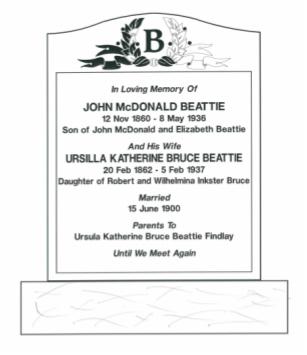
Almost a year after finding the unmarked grave of Ella’s maternal grandparents, John McDonald Beattie (1860-1936) and Ursilla (pronounced “Yer-SILL-a”) Katherine Bruce Beattie (1862-1937), in Aberdeen, Scotland, we received word from the mason last week that we finally have a gravestone in place. Hooray!

This grave had been unmarked for over 80 years, and through this blog, we became acquainted with our dear cousins in New Zealand (in 2015), who introduced us to other dear cousins in Aberdeen (in 2017), who happened to have the original receipts that proved our family’s ownership of the plot.


While visiting Aberdeen last May, we found the plot through the help of a couple gravediggers who were referencing tattered maps that were stored in a drawer in a small, unmanned cemetery office (there were no digital maps or maps posted in the cemetery itself). We had to get additional approvals from Aberdeen City to move ahead. I received quotes from multiple masons, vetted them based on recommendations from local cousins, the local genealogical society, and the bereavement/burials division of Aberdeen City.

Until We Meet Again
(Photo taken by the mason)
John McDonald Beattie with wife
Ursilla Katherine Bruce Beattie
There would be stretches of time in the past year where I wasn't sure how exactly this process would play out, so I would focus instead on taking a little step each day: Consult family members for their feedback on the research; talk to a mason local to me to get their perspective on this project; consult a professional genealogist about inscriptions that are meaningful and helpful; reach out to genealogical societies for advice; converse with friends about the status of the project and get their take as well.

As we would forge ahead on this project, I would sometimes get overwhelmed, wanting to make sure that everything was perfect and done correctly, feeling at a disadvantage trying to manage this from the other side of the world, feeling regret that the grave has been unmarked for 80+ years. But I took comfort in something that a local Bay Area mason told me: There has never been a better time to tackle a project like this. When we look at how easily we can communicate over email, Skype, send digital photos back and forth, research and fact-check with historical documents online in searchable databases, connect virtually with cousins - so much of this wasn't as easy even 5 years ago. Now was the right time.

This stone is intended to be a Rosetta stone of sorts, not just including the names and birth and death dates of John and Ursilla, but also the names of their parents, their marriage date, and their only child’s name. We want future generations to come back to this spot, and to realize exactly how their ancestors fit into the family tree.


And this stone will act as a testament that John and Ursilla’s lives mattered and that their memory lives on - despite their poverty (an orphaned iron worker and a domestic servant/dressmaker), their handicaps (they were both deaf since childhood), and their initially small posterity (they had only 1 child, who then had just 2 children. But the generations have really grown since then.)

A huge THANK YOU to all the family members who collaborated on this project - through sharing ideas as well as financial contributions. It's been quite the journey over the past year, working together to see this to completion.

One of my favorite parts of the stone is the final line, "Until We Meet Again." Indeed, if we believe in an after life, then until we meet the Beatties again, and until we meet with each other again in this life. It represents such hope and love.


.…..….
See also:
  1. John McDonald and Ursilla Katherine Bruce Beattie - Final Resting Spot: https://greatflyingscots.blogspot.com/2017/05/john-mcdonald-and-ursilla-katherine.html
  2. John McDonald Beattie (1860-1936) - According to His Daughter, Kate: http://greatflyingscots.blogspot.com/2018/04/john-mcdonald-beattie-according-to-his.html
  3. Meet Ursilla Katherine Bruce Beattie (1862-1937): https://greatflyingscots.blogspot.com/2017/02/meet-ursilla-katherine-bruce-beattie.html
  4. Williamina/Wilhilmina/Wilhelmina - A Rose by Any Other Name...: https://greatflyingscots.blogspot.com/search/label/Wilhilmina%20Inkster%20%281835-1896%29

John McDonald Beattie (1860-1936) - According to His Daughter, Kate

John McDonald and
Ursilla Katherine Bruce Beattie
In July 2017, cousin ES shared with me the Life History of George and Kate Findlay, a document featuring an oral history recorded and transcribed by George and Kate’s grandson, NS, and some sections composed by Kate herself. It has such a wealth of information, and George and Kate’s granddaughter BR said, “It sounds just like Grandma used to talk.” 

Some of the information included in this life history are details of Kate’s parents (Ella's maternal grandparents), John McDonald Beattie (1860-1936) and Ursilla (pronounced "yer-SILL-a) Katherine Bruce Beattie (1862-1937).

As we are in the process of having a gravestone placed on John and Ursilla’s currently unmarked grave in Allenvale Cemetery, Aberdeen, Scotland, I thought I’d include excerpts from George and Kate’s history here. 

This is John McDonald and Ursilla Katherine Bruce Beattie, according to their only child, Ursula (pronounced "ER-sill-a) Katherine Bruce Beattie Findlay, known to most as Kate. 

Kate described her parents as having "lived a happy married life together… . They never had too much money but love abided in their home." What a tender tribute!

Also see the blog post about John's wife, Ursilla Katherine Bruce Beattie, here (https://greatflyingscots.blogspot.com/2017/02/meet-ursilla-katherine-bruce-beattie.html). 

And please note: I’ve added clarifying details to Kate's narrative in brackets.
..........

My father [John McDonald Beattie] was born in Aberdeen, Scotland of humble parentage. His mother [Elizabeth Beattie] was not married and had to work for her living at a Jute works [flax mill]. Her folks [Adam and Janet Petrie Beattie] looked after the baby while she was at work. 

His mother [Elizabeth Beattie] had gone with this man [John McDonald] and she became pregnant and then she found out he was a married man. He came from Grantown and that’s down by Leith. He must have been doing a job up there in Aberdeen. She proved it through the courts. 

Of his childhood I know nothing until he reached the year of 10. [This date might be slightly off as his mother passed when he was 9 years old, and he was living at the Aberdeen Institute for the Deaf and Dumb just after he turned 10. See the footnote 1 for more details.](1)

This was a turning point in his life as one day while playing near the fire in the kitchen a large pot, which was hanging [with chains] over the fire with boiling water in it, fell on him and the shock took away his hearing also speech…I don’t know if it was the pot or the water that struck him. He didn’t have any marks on his face but he was totally deaf and I only once heard him speak and the only time I ever him angry. He never lost his temper but this time he did. He swore and that was the only word I ever heard my father say. 

But my father, after his accident, his mother was a [flax] mill worker, and I suppose she couldn’t look after him but she could have done better than she did….The family being poor could not look after him or educate him as they put him into a school for the deaf.  But in doing so they seem to have deserted him completely as from that day till he was sixteen years of age they never visited him. So in his pride he in turn did not go visit them the remainder of his life.(2)

[The home that he was put in is] still there but I don’t know what it’s used for now but it was a small
John McDonald and
Ursilla Katherine Bruce Beattie
home.(3) He never said he was cruelly used. He said that he stayed there until he was 16 but she never came to see him. She never sent a card at Christmas time or took him out at vacation time and so he wouldn’t go and see her. I got that same pride. So I never went to see his folks. I’ve done their genealogy but I’ve never seen them. 


He took up the trade of Boiler making.(4) 

In Aberdeen there was an excellent Deaf and Dumb Institute … on Rose Street in Aberdeen (5) ... so in the evenings he went there and met others like himself and played draughts or cards or billiards. On Sundays going to service at the church attached to the Institute. He met my mother there. She was just on a visit to Aberdeen on her way back home to Shetland Islands. 

[The Deaf and Dumb Institute is] … a very nice building with three floors and as you went in the door there was the office. It was kept up mostly by donations from wealthy families all around. Workplaces used to have a work day that they donated. The big houses, the families like Lady Birnie, were very good to the deaf. 

On the bottom floor as you walked along the passage there was a great big dance hall and there was a stage and a kitchen. They used to have parties and the Christmas parties with a great big Christmas tree. 

There were dances once a month and the floor was wooden and it always was kept polished so that they could dance beautifully. When they danced the floor bounced and the music was felt with their feet and they could keep up with it and dance and some of them were real good dancers.

Upstairs was a small church that was very pretty and very nice and they always had a good service and the singing was all done by the hands. Next to that a big kitchen and that was where they had classes for the women. Sewing, baking, and all that kind of stuff. 

Upstairs again was a big, real nice room for the men. It had billiard tables and all kinds of games. The other room was a reading room and there the best of magazines. We could borrow a book from the library. The children of the families all knew each other and were good pals and went to the picnics and parties. Very few that are married, that both of them are deaf and dumb that have deaf children. In those days measles caused deafness mostly and diphtheria and scarlet fever or an accident like my father and my mother. It’s very seldom that they are born deaf.

[My mother’s] family were not pleased at [my parent’s] courtship as my father came of working people, however, they saw that they were suitably married and then washed their hands of my mother. She was 38 years of age when she married; their first baby was born when she was 40 and the baby died before birth. Then two years later I was born to them. 

She and my dad lived a happy married life together….They never had too much money but love abided in their home. 

My father in disposition was of a happy nature. Kindly and loving. To my knowledge he had a smooth, uneventful life just doing day by day normal things of life….He was a good man, a gentle person. He had a sense of humor, that’s where I get mine. He would tease my mother….He lived till he was 76 years of age. 

In that time I tried to find out about his people but could find nothing and even I went to the Edinburgh Registrar Office but I couldn’t find anything. He was known by the name of John McDonald Beattie. His mother was Elizabeth Beattie so she had registered him in her own name. 

However in July of 1954 a dear friend of mine in Edinburgh, Scotland wanted to know if she could do anything for me. So I wrote her asking if her son who was on vacation in Edinburgh could go to the Registrar Office and see if he could get information on my father’s mother as I knew nothing of his father I couldn’t ask about him. Well in September 1954 his reply came back and the reply was that he had discovered a statement which said that the Elizabeth Beattie had proved the parentage of her child John McDonald Beattie to one named John McDonald. 

[In January 1864, a little over 3 years after John was born, his mother Elizabeth had the birth entry corrected.] "In an action relating to the paternity of a child named John McDonald Beattie born on or about 31 October 1860, at the instance [?] of Poor Elizabeth Beattie, Millworker, [?] St. Andrew Street, Aberdeen, against John McDonald, Boilermaker, Kirkpatricksland, [?] Street, …. the Sheriff of Edinburghshire on the 10th of December 1863, found that the said child was the Illegitimate child of the parties afore[?]."(6)


..........
John passed away on 8 May 1936, when he was 75 years old, of chronic endocarditis, chronic bronchitis, and a peptic ulcer, at his home at 26 1/2 Bank Street, Aberdeen. He and Ursilla (who passed away the following year) are buried in Allenvale Cemetery in Aberdeen.(7)
..........
Notes and Sources:

  1. Per statutory death records, Elizabeth Beattie passed away on 7 July 1869, when John was 9 years old. Perhaps he lived with Elizabeth’s parents after that? Or were they already living with them? In any case, Elizabeth’s parents, Adam and Janet Petrie Beattie soon passed also, on 25 Mar 1869 and 26 October 1869, respectively. 
  2. Through email correspondence with Aberdeen University, which keeps some records on the Aberdeen Institute for the Deaf and Dumb, I learned the following on 13 Oct 2017: “I have checked through the minute book of the Aberdeen Institute for the Deaf and Dumb (MS 3428/2) and found a reference to a John Beattie: “November 28th 1870 - John Beattie, an orphan illegitimate sent by St Nicholas Parochial Board joined the institution Thursday 24th November.” It’s heartbreaking to think that, per Kate’s understanding of his childhood, that his family never visited or wrote letters and had abandoned him, but in reality, they had all passed away. However, I'm wondering where John lived or who he lived with between the time his grandmother died (26 October 1869) and he was admitted to the Aberdeen Institute for the Deaf and Dumb on 28 November 1870.
  3. I wonder, where was this building, that was an orphanage/home for deaf children?
  4. Still to do: Research more about the ironworker trade and the Aberdeen Iron Foundry (location, examples of work, etc.)
  5. I also wonder whether the building on Rose street that housed the Aberdeen Institute for the Deaf and Dumb is still there?
  6. Wow, did John's mother, Elizabeth have guts! It was 3 years after John's birth that she had his birth entry corrected to include John's father's name. But we're so glad she did! She must have been a strong woman, despite the apparent ridicule she received, insulting her by calling her "poor Elizabeth."
  7. Read more about John McDonald and Ursilla Katherine Bruce Beattie's final resting spot here: https://greatflyingscots.blogspot.com/2017/05/john-mcdonald-and-ursilla-katherine.html

John McDonald and Ursilla Katherine Bruce Beattie - Final Resting Spot

On that windy, overcast morning in May, when we decided to visit the Allenvale Cemetery to find the unmarked(1) graves of Ella’s maternal grandparents, John McDonald Beattie and Ursilla Katherine Bruce Beattie (pronounced "Yer-SILL-a")(2), it seemed like it would be a fairly easy task, as we knew the cemetery section and plot number of the graves.(3) But as the events unfolded, it truly seemed that there was divine intervention to guide us in our efforts.

We had arrived in Aberdeen the afternoon on the previous day, and that evening at the hotel we met Ella’s first cousin CS for the first time.

After some introductions, she said that our visit had prompted her to revisit and sort through some documents that she inherited when her older sister had passed away. Included in these documents, which she unfolded so gently as some were quite delicate, were two hand-written receipts for Allenvale Cemetery, to George Findlay (Ella's father), dated 11 May 1936 and 8 February 1937.

Hand-written receipt to George Findlay for the payment
of a funeral plot at Allenvale Cemetery

In that moment, it didn’t make sense what those receipts would have been for. This was about 13 years before George and Kate Findlay (Ursula Katherine Bruce Beattie Findlay) and their family would emigrate and at that time they were just in their early 30s. Were they buying this plot to plan for their future?(4) We were planning on visiting that cemetery the next day, so we would do some further investigating while there.

The next morning, before we headed out for the day, I took another look at the receipts for the cemetery plots, and it hit me: The plot numbers listed there were for George Findlay’s in-laws, John McDonald and Ursilla Katherine Bruce Beattie. And the dates on the receipts were just days after they had both passed.(5) It now made sense: John and Ursilla had only one child, their daughter Kate, and thus after they passed, it would be Kate and her husband George who would provide for their burial.

……….

Allenvale Cemetery is such a beautiful cemetery, with tall trees and neat rows of headstones of various shapes and sizes. And it’s huge: it must have thousands and thousands of graves.

Allenvale Cemetery - thousands and thousands of graves!

We knew the grave location—section 2, lair/plot 278—but I was unable to find a cemetery map online, so we thought there might be some sort of sign or map at the cemetery itself. So we entered through the gates by Allenvale Road and Hardgate, and we walked in. Wow, was it overwhelming! With so many graves, how would we know where to begin?

The entrance to Allenvale Cemetery
off of Allenvale Road and Hardgate.
I ran ahead, looking for any plaques, maps, or markers, but I wasn’t  able to find anything. Instead, perhaps there might be an office, or a groundskeeper who could direct us?

After working my way through section after section of the cemetery, then across the street in yet another section, I saw a couple of chaps, and asked them whether they could help me find the plot. Sure! They were happy to help! They brushed their hands off on their overalls and apologized for the dirt - they were busy digging graves by hand that morning.

We entered into a small office on the side of a home in that part of the cemetery, and G, the energetic and friendly grave digger, pulled out a tattered map from a drawer. Wow, this office! It was not an “office” in the modern sense, but an unfinished room attached to a home, with a couple tables, perhaps a chair, and aged maps, barely being held together by threads, rolled up in the drawers. There was also a cabinet full of hand-written ledgers of burial records and loose papers, tucked onto the shelves. Nothing digitized - no wonder I couldn’t find this information online!

Confirming the location of the family plot.

Gathering around the map.

Hand-written ledgers of burial records.
G checked the map for the location I noted (section 2, lair/plot 278). The area we were interested in was right on a torn seam, so he was carefully rolling frayed pieces of the map down to try to piece it together. “Ah!” he says. “G. Findlay!” “Yes! That’s the one!” Why “G. Findlay” on the map? Because that’s who paid for the plot, even though he is not buried there. And because of the documents Cousin CS shared with us the night before, it was all making sense; there was no confusion about why G. Findlay’s name would be on the map.

"G. Findlay," located on that ripped seam.
Now that we had confirmed the general area, G grabbed the map and we headed out across the cemetery, with his fellow grave digger A following along.

We actually went back to the section of the cemetery near where we had parked our car and had initially walked in. We were so close already! G would energetically check the map, walk a few paces, check the map, get down on his hands and knees to check grave stones, removing his glasses, putting them back on, moving to the next spot with this ragged map billowing in the wind as he walked. Assuming that our family’s plot had no grave marker, we were checking the adjacent graves that had tomb stones, comparing them to the map. Our anticipation kept growing! We were on the verge of finding the plot!

Checking the map. So close now!
G and A thought they identified the spot, but there seemed to be another grave marker placed there - a loose one. As often happens, the stones might be moved for maintenance or groundskeeping work, and then erroneously placed back in the wrong spot. It appeared we had a squatter!

However, after closer inspection of the map, G confirmed that the grave we were looking for was right where we were standing, denoted by a small tin pot mostly submerged in the dirt (that perhaps held flowers at some time). We found it! What a thrilling treasure hunt! And how grateful we were for the help of these cheery grave diggers.


We were on the hunt! Found it!

The submerged tin pot in front of Ralph's left toe marks
the final resting place of John and Ursilla Beattie.


We lingered at the gravesite longer, marveling at the events of the day and so very grateful. Grandma Ella and I picked some of the tiny wildflowers that were growing in the lawn and laid a petite bouquet of wild daisies and dandelions on their graves.

A tiny bouquet, in remembrance.
……….

These are the graves of my great great grandparents, John McDonald Beattie and Ursilla Katherine Bruce Beattie. From what I’ve learned of them, life was not easy for them but they seem to have had strong characters. Both were deaf since childhood but that didn’t seem to hold them back. He was born in Aberdeen, an illegitimate child, his mother died when he was 9 and he grew up in an orphanage. She was born in Shetland. Her father died when she was 3 years old, and she spent 6 years at a boarding school for deaf students in Edinburgh. They married in their late 30s and had one child in their early 40s, whom they raised to be a strong, stalwart woman - Ursula Katherine Bruce Beattie Findlay (“Grandma Kate”), Ella’s mother. He worked in the Aberdeen iron foundry, dying of chronic bronchitis when he was 75. She was trained as a dressmaker and had worked for a time as a domestic servant as well. She died at age 74 of uterine cancer. Ella was just 2-3 when they died, so she doesn’t have any first-hand memories of them, though she heard much about them growing up.

……….

All coincidence perhaps, but I like to believe that the hand of God was helping orchestrate the day’s events, that through inspired thoughts and actions (including the receipts that Cousin CS shared and meeting the grave diggers), we were guided to answers, that so many little pieces and people came together to lead us to where our ancestors were laid to rest. Perhaps we would have found this information eventually regardless? But it all certainly came together in a way we couldn’t have anticipated.

What’s next? We are waiting to hear back from the burials office of Aberdeen City(6), as it’s time we have a proper gravestone marker put in place. “Until we meet again.”

……….


If you find yourself at Allenvale Cemetery in Aberdeen, Scotland, here are directions
for how to find the (currently) unmarked graves of John McDonald Beattie
and Ursilla Katherine Bruce Beattie.

……….
Notes:

  1. We weren’t 100 percent certain that the graves of John McDonald Beattie and Ursilla Katherine Bruce Beattie were unmarked, but we had vague memories of oral history recounting such.
  2. Ella’s maternal grandparents, John and Ursilla Beattie, passed away when Ella was 2-3 years old. I wonder whether Ella had ever visited the graves with her parents before they emigrated?
  3. The plot locations of John and Ursilla Beattie at Allenvale Cemetery were confirmed via email with a Bereavement Services Registrar at Marischal College on 5 Oct 2016.
  4. It also isn't apparent why George’s sister would have been the caretaker of these receipts, which were then passed to her daughters (eventually to Cousin CS), as these were for plots for George’s in-laws, not related to the Findlays. But for whatever reason, we were glad they were preserved!
  5. John McDonald Beattie: 12 November 1860 - 8 May 1936. Ursilla Katherine Bruce Beattie: 19 Feb 1862 - 6 Feb 1937.
  6. When I called Aberdeen City to inquire about getting a proper gravestone for their graves, they asked who had paid for the plot. Ah-hah! “I’ve got the receipts for that: George Findlay.”

John and Ursilla Beattie are Ella's
maternal grandparents.