Showing posts with label Ursilla Katherine Bruce (1862-1937). Show all posts

An Error in a Census Record and Recruiting Guardian Angels

Sometimes as I'm researching records and trying to find missing pieces to our family
John and Ursilla
on their wedding day, 1900

history puzzle, I let out an audible, "Ah-hah!" And today that was accompanied by, "I found you! Yeah!"


I've been looking for census records for John McDonald Beattie (1860-1936)  and his wife Ursilla Katherine Bruce (1862-1937) (Ella's maternal grandparents), but I was having trouble finding a record for 1901.

I knew that the couple was married in Edinburgh in 1900 and that their daughter, Ursula, was born in Aberdeen in 1904, so I was looking at both locales as possibilities.

Then a particular record seemed to jump out at me. It was one that I had looked at before and dismissed, but I looked at it with closer scrutiny this time.

This is the 1901 Scotland Census in the civil parish of Aberdeen. (See and/or download full document here.)

It lists John Beattie as the head of the household, married, 40 years old; an ironworker, born in Aberdeen, and deaf; living at 35 Broomhill Road, Aberdeen.

His wife is listed as Isabella, 39 years old; born in Shetland, and deaf as well. 


We know that John and wife Ursilla were living at 35 Broomhill Road in 1904 when their daughter was born; and all of the other information about ages, occupation, where born, and both being deaf match exactly with what we know about John and Ursilla. This clearly seems like a clerical error with Ursilla's name erroneously recorded as Isabella.

I found you!

..........

As I'm searching and trying to learn more details about the lives of our ancestors, I sometimes smile at the thought that perhaps I'm recruiting guardian angels on my family's behalf. As I'm looking out for them, maybe they're looking out for us?

More details about John and Ursilla in these posts:

John McDonald Beattie (1860-1936) - According to His Daughter, Kate

John McDonald and
Ursilla Katherine Bruce Beattie
In July 2017, cousin ES shared with me the Life History of George and Kate Findlay, a document featuring an oral history recorded and transcribed by George and Kate’s grandson, NS, and some sections composed by Kate herself. It has such a wealth of information, and George and Kate’s granddaughter BR said, “It sounds just like Grandma used to talk.” 

Some of the information included in this life history are details of Kate’s parents (Ella's maternal grandparents), John McDonald Beattie (1860-1936) and Ursilla (pronounced "yer-SILL-a) Katherine Bruce Beattie (1862-1937).

As we are in the process of having a gravestone placed on John and Ursilla’s currently unmarked grave in Allenvale Cemetery, Aberdeen, Scotland, I thought I’d include excerpts from George and Kate’s history here. 

This is John McDonald and Ursilla Katherine Bruce Beattie, according to their only child, Ursula (pronounced "ER-sill-a) Katherine Bruce Beattie Findlay, known to most as Kate. 

Kate described her parents as having "lived a happy married life together… . They never had too much money but love abided in their home." What a tender tribute!

Also see the blog post about John's wife, Ursilla Katherine Bruce Beattie, here (https://greatflyingscots.blogspot.com/2017/02/meet-ursilla-katherine-bruce-beattie.html). 

And please note: I’ve added clarifying details to Kate's narrative in brackets.
..........

My father [John McDonald Beattie] was born in Aberdeen, Scotland of humble parentage. His mother [Elizabeth Beattie] was not married and had to work for her living at a Jute works [flax mill]. Her folks [Adam and Janet Petrie Beattie] looked after the baby while she was at work. 

His mother [Elizabeth Beattie] had gone with this man [John McDonald] and she became pregnant and then she found out he was a married man. He came from Grantown and that’s down by Leith. He must have been doing a job up there in Aberdeen. She proved it through the courts. 

Of his childhood I know nothing until he reached the year of 10. [This date might be slightly off as his mother passed when he was 9 years old, and he was living at the Aberdeen Institute for the Deaf and Dumb just after he turned 10. See the footnote 1 for more details.](1)

This was a turning point in his life as one day while playing near the fire in the kitchen a large pot, which was hanging [with chains] over the fire with boiling water in it, fell on him and the shock took away his hearing also speech…I don’t know if it was the pot or the water that struck him. He didn’t have any marks on his face but he was totally deaf and I only once heard him speak and the only time I ever him angry. He never lost his temper but this time he did. He swore and that was the only word I ever heard my father say. 

But my father, after his accident, his mother was a [flax] mill worker, and I suppose she couldn’t look after him but she could have done better than she did….The family being poor could not look after him or educate him as they put him into a school for the deaf.  But in doing so they seem to have deserted him completely as from that day till he was sixteen years of age they never visited him. So in his pride he in turn did not go visit them the remainder of his life.(2)

[The home that he was put in is] still there but I don’t know what it’s used for now but it was a small
John McDonald and
Ursilla Katherine Bruce Beattie
home.(3) He never said he was cruelly used. He said that he stayed there until he was 16 but she never came to see him. She never sent a card at Christmas time or took him out at vacation time and so he wouldn’t go and see her. I got that same pride. So I never went to see his folks. I’ve done their genealogy but I’ve never seen them. 


He took up the trade of Boiler making.(4) 

In Aberdeen there was an excellent Deaf and Dumb Institute … on Rose Street in Aberdeen (5) ... so in the evenings he went there and met others like himself and played draughts or cards or billiards. On Sundays going to service at the church attached to the Institute. He met my mother there. She was just on a visit to Aberdeen on her way back home to Shetland Islands. 

[The Deaf and Dumb Institute is] … a very nice building with three floors and as you went in the door there was the office. It was kept up mostly by donations from wealthy families all around. Workplaces used to have a work day that they donated. The big houses, the families like Lady Birnie, were very good to the deaf. 

On the bottom floor as you walked along the passage there was a great big dance hall and there was a stage and a kitchen. They used to have parties and the Christmas parties with a great big Christmas tree. 

There were dances once a month and the floor was wooden and it always was kept polished so that they could dance beautifully. When they danced the floor bounced and the music was felt with their feet and they could keep up with it and dance and some of them were real good dancers.

Upstairs was a small church that was very pretty and very nice and they always had a good service and the singing was all done by the hands. Next to that a big kitchen and that was where they had classes for the women. Sewing, baking, and all that kind of stuff. 

Upstairs again was a big, real nice room for the men. It had billiard tables and all kinds of games. The other room was a reading room and there the best of magazines. We could borrow a book from the library. The children of the families all knew each other and were good pals and went to the picnics and parties. Very few that are married, that both of them are deaf and dumb that have deaf children. In those days measles caused deafness mostly and diphtheria and scarlet fever or an accident like my father and my mother. It’s very seldom that they are born deaf.

[My mother’s] family were not pleased at [my parent’s] courtship as my father came of working people, however, they saw that they were suitably married and then washed their hands of my mother. She was 38 years of age when she married; their first baby was born when she was 40 and the baby died before birth. Then two years later I was born to them. 

She and my dad lived a happy married life together….They never had too much money but love abided in their home. 

My father in disposition was of a happy nature. Kindly and loving. To my knowledge he had a smooth, uneventful life just doing day by day normal things of life….He was a good man, a gentle person. He had a sense of humor, that’s where I get mine. He would tease my mother….He lived till he was 76 years of age. 

In that time I tried to find out about his people but could find nothing and even I went to the Edinburgh Registrar Office but I couldn’t find anything. He was known by the name of John McDonald Beattie. His mother was Elizabeth Beattie so she had registered him in her own name. 

However in July of 1954 a dear friend of mine in Edinburgh, Scotland wanted to know if she could do anything for me. So I wrote her asking if her son who was on vacation in Edinburgh could go to the Registrar Office and see if he could get information on my father’s mother as I knew nothing of his father I couldn’t ask about him. Well in September 1954 his reply came back and the reply was that he had discovered a statement which said that the Elizabeth Beattie had proved the parentage of her child John McDonald Beattie to one named John McDonald. 

[In January 1864, a little over 3 years after John was born, his mother Elizabeth had the birth entry corrected.] "In an action relating to the paternity of a child named John McDonald Beattie born on or about 31 October 1860, at the instance [?] of Poor Elizabeth Beattie, Millworker, [?] St. Andrew Street, Aberdeen, against John McDonald, Boilermaker, Kirkpatricksland, [?] Street, …. the Sheriff of Edinburghshire on the 10th of December 1863, found that the said child was the Illegitimate child of the parties afore[?]."(6)


..........
John passed away on 8 May 1936, when he was 75 years old, of chronic endocarditis, chronic bronchitis, and a peptic ulcer, at his home at 26 1/2 Bank Street, Aberdeen. He and Ursilla (who passed away the following year) are buried in Allenvale Cemetery in Aberdeen.(7)
..........
Notes and Sources:

  1. Per statutory death records, Elizabeth Beattie passed away on 7 July 1869, when John was 9 years old. Perhaps he lived with Elizabeth’s parents after that? Or were they already living with them? In any case, Elizabeth’s parents, Adam and Janet Petrie Beattie soon passed also, on 25 Mar 1869 and 26 October 1869, respectively. 
  2. Through email correspondence with Aberdeen University, which keeps some records on the Aberdeen Institute for the Deaf and Dumb, I learned the following on 13 Oct 2017: “I have checked through the minute book of the Aberdeen Institute for the Deaf and Dumb (MS 3428/2) and found a reference to a John Beattie: “November 28th 1870 - John Beattie, an orphan illegitimate sent by St Nicholas Parochial Board joined the institution Thursday 24th November.” It’s heartbreaking to think that, per Kate’s understanding of his childhood, that his family never visited or wrote letters and had abandoned him, but in reality, they had all passed away. However, I'm wondering where John lived or who he lived with between the time his grandmother died (26 October 1869) and he was admitted to the Aberdeen Institute for the Deaf and Dumb on 28 November 1870.
  3. I wonder, where was this building, that was an orphanage/home for deaf children?
  4. Still to do: Research more about the ironworker trade and the Aberdeen Iron Foundry (location, examples of work, etc.)
  5. I also wonder whether the building on Rose street that housed the Aberdeen Institute for the Deaf and Dumb is still there?
  6. Wow, did John's mother, Elizabeth have guts! It was 3 years after John's birth that she had his birth entry corrected to include John's father's name. But we're so glad she did! She must have been a strong woman, despite the apparent ridicule she received, insulting her by calling her "poor Elizabeth."
  7. Read more about John McDonald and Ursilla Katherine Bruce Beattie's final resting spot here: https://greatflyingscots.blogspot.com/2017/05/john-mcdonald-and-ursilla-katherine.html

Williamina/Wilhilmina/Wilhelmina - A Rose By Any Other Name...

Wilhelmina Inkster Bruce/Campbell
In his play Romeo and Juliet, Shakespeare penned, “What's in a name? That which we call a rose by any other name would smell as sweet.” It’s true that what matters is who a person is rather than what their name is...and in this case how their name is spelled or how it’s pronounced.

That being said, when it comes to how to spell Grandma Ella’s great grandmother's name, it’s something that keeps me up at night. After all, her name will be inscribed on her daughter’s granite memorial, Ursilla Katherine Bruce Beattie.(1) I want to get it right!

On 10 March 1835, a daughter was born out of wedlock to William Inkster and Margaret Graham. (Read more about her life here and here.) According to what Grandma Ella was taught, she was called “WILL-yum-INE-A,” but how might that have been spelled?

In researching this and trying to come to a conclusion on which spelling to adopt as “official,” here’s an overview of records I've found - parish, statutory, and family records - with different spellings of her name throughout her life:(2)

  • Parish birth record for Williamina Inkster, 13 March 1835
  • Census entry for Williamina Inkster, 1841, when she was still in her father William's household
  • Bruce family register that mentions marriage of Robert and Wilhelmina, 1 May 1855
  • Statutory birth register for Robert and Wilhilmina's son Robert, 6 July 1857
  • Statutory birth register for Robert and Wilhilmina's daughter Ursilla, 20 Feb 1862
  • Census entry for Wilhilmina, 1861
  • Statutory marriage register for Wilhelmina and 2nd husband, Duncan Campbell, 24 Feb 1870
  • Statutory birth register for Alexander Campbell, son of Wilhelmina from her 2nd husband, 25 Nov 1870
  • Statutory death register for Wilhelmina, 28 Dec 1896
  • A note from Gma Ella sent to me in 2014 that says she has always gone by the spelling Williamina
  • A handwritten family group sheet from Grandma Ella’s mother, Ursilla Katherine Bruce Beattie Findlay (“Grandma Kate”) with the spelling as Wilhelmina. This is Grandma Kate’s grandmother whose name spelling we’re debating. Although Wilhelmina passed away before Grandma Kate was born, she was the closest person to her that we knew.

Now it’s true that perhaps even if her name was spelled as Wilhilmina or Wilhelmina, that it could have still been pronounced as “WILL-yum-INE-A.” Sometimes names are not necessarily pronounced phonetically, so we can’t always make an assumption about a name’s pronunciation from 180+ years ago.

And it’s true that sometimes in this bygone era, a person was not literate, so a registrar would make his best guess when recording that person’s name on an official document. And thus it’s hard to confirm one “official” spelling.

We could debate that her name should be spelled as Williamina, as it appears that that’s how her father had intended it. Or we could debate that it should be Wilhelmina, as many of the official records later in her life were spelled that way - perhaps that was the spelling that she adopted and used (assuming she was literate, or literate enough to spell her name later in her life).

Ultimately, we recognize that there is probably no “right” way to spell her name considering this time in history. And anyone versed in family history will know that spelling variations are common so when researching ancestors it’s a best practice to search on the spelling variations also.

But I still wish there were one, definitive, right way. ;)

……….
Sources and Notes:
  1. More on finding the unmarked grave of Wilhelmina’s daughter, Ursilla Katherine Bruce Beattie, here (https://greatflyingscots.blogspot.com/2017/05/john-mcdonald-and-ursilla-katherine.html).
  2. Most of these documents I found on ScotlandsPeople (https://scotlandspeople.gov.uk), though the Bruce family register is a copy that Grandma Ella shared with me - I’m not sure where the original is or who shared the copy with her. I’m in the process of posting documents to FamilySearch (https://www.familysearch.org/), but if you’d like a copy of them in the meantime, send me an email and I can share them with you directly.

Wilhelmina Inkster Bruce/Campbell is Ella's great grandmother.

George and Kate Findlay Meet the Mormons

How were George and Kate Findlay first introduced to the Mormon church? That was such a pivotal moment that would lead to their conversion and forever change the course of their lives. But it was a detail that remained a mystery to many of their descendents until this past July, when cousin ES (a great grandson of George and Kate) shared a scanned copy of the Life History of George and Katherine Findlay. This is their life history as Kate told to her grandson NS, who recorded it on tapes and it was later transcribed. Thank you to the various S Family members who worked to preserve these details!

The information below is an excerpt from that history. The formatting has been adjusted slightly to improve readability, and minor clarifications have been added in brackets. 

If you have additional details to add or any clarifications to make, please do! Send that to me via the "Contact Form" at the bottom of this page.
..........

We got married in 1927 and in 1930 we thought we would like to have a holiday. I wrote to a friend of my mother’s from Shetland, a Mrs. Smith. She lived in Leith [just north of Edinburgh]. She wrote back and said they had a room. I had said to ask for bed and breakfast because then we could go out and just come back anytime. This woman, Mrs. Smith, when we went to the address there was a note on the door that said, very sorry but have been sent for to go to Shetland because my mother is very ill. Go to Mrs. [Agnes] Jamieson who lives next door and she will take you.

We went there and she was a nice lady and I know she was from Shetland from the way she spoke. Next morning at breakfast she said to me, “Mrs. Findlay, are you a Bruce?” I said, “Well my mother was a Bruce and Bruce is in my name.” She said, “I thought so. Was your mother(1) born in Burravoe?” I said she was. “Well”, she said, “My father was bailiff to your mother’s mother and father.” A bailiff is like a manager to an estate.

Now my mother had told me things about the place and she had said they had been a well-known family and had money, but it went in here and out there because I didn’t know if it was true or not. I have faint recollections of being in Shetland. She took me there and I did know that I was in a big house. This woman said my mother was telling the truth. She said, “If you look out my window (and she lifted the window) and if you look out from here down to there (and this was the end of the street). That is the length of the banqueting hall.” I was quite surprised.

The Manor House in Burravoe, Yell, Shetland, where Kate's mother Ursilla
Katherine Bruce was born - Photo taken Sept 2014
Then she says, “Oh but you know you had relatives that came to see me.” I said, “Relatives! I havena got such a thing. I’m an only child and mother’s two brothers died. I don’t have any relatives.”

She said, “Oh, but you do. They are from America. These two fellas that came to the door and one of them was looking for me," said Mrs. Jamieson. The family in America, they knew her name and where she lived because the station her father had, had been manager, and she said these fellas want very much to get in touch with your mother. I thought, “That’s strange. I can’t understand that because she has no relatives in America. She has an uncle in Australia but he would be dead now and he made money in beer. He built a big factory and was a millionaire."

She said, “But you do have relatives in America.” She described him and he was a very nice clean living boy and there is one thing I have to tell you. They were Mormons.(2)

George and me nearly had a fit because you know Mormons were something terrible and I was afraid of them. They would be back but they hadn’t been yet. I left my address and said I would be glad to see them.

That was July and we were on holiday in Edinburgh and when we went back I spoke to my mother about it, and she said yes, she knew Mrs. Jamieson, and I asked about this family in America. She thought a minute and said she knew.

Her aunt Mary Bruce married a Scott Anderson and they became Mormons and had five children. And he was a lawyer and left from Liverpool to go to Salt Lake City. And they were never heard from again.

Scott and Mary Bruce Anderson. Image source: Family Search

Elder William S. Costley was the first
missionary to contact George and Kate
Findlay in Aberdeen in October 1930.
Image Source: Life History of George
and Katherine Findlay
That was July and in October a knock comes to the door and it was this young fella in a black suit and he offered me a pamphlet. I took it and he represented The Church of Jesus Christ of Latter-day Saints. I said I had never heard of it and he said it was better known as the Mormons. From there on the missionaries came and I was ready for them. That missionary lived in Ogden and his name was Elder Costley.(3)

At that time one missionary went down one side of the street and the other missionary went down the other side. He said his companion was across the street and could they come and visit and they would tell more about the gospel. I thinks to myself - Mormons - they can’t come here. But I said, well come on Saturday and from then on the elders came.

Well to finish the story about Mary and Scott Anderson. Every different elder that came I asked to try and find them but it seemed that there were lots of Andersons in Salt Lake City. Two years passed and then we joined the church. I was ready to join in a year but I waited for George.

Kate was baptized on 11 June 1932 by branch president Le Grand Gentry Sharp and confirmed on 12 June 1932 by missionary Elder Carl Condie.(4) George was baptized on 13 June 1932.(5)

Certificate of Baptism for Ursula Katherine Bruce Findlay, 11-12 June 1932
Source: Life History of George and Katherine Findlay
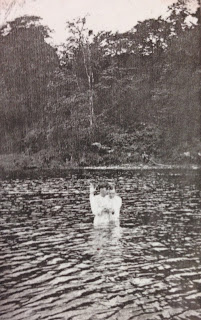
Baptism of George Findlay in the
River Dee - 13 June 1932

The following year after we were baptized, Patriarch [James H. Wallis], the only patriarch that had ever been to Scotland, came and it was announced that we could have a patriarchal blessing. None of us had ever heard of patriarchal blessings and we didn’t know what it was. They said to put your name in if you were in good standing and you would have to go to Glasgow where they were having conference.

We decided we couldn’t ask for a blessing because we had only been members for a year. The elders came on Saturday and said they hadn’t heard from Brother Findlay that we wanted a blessing. George said he didn’t know what a blessing was and anyway they had only been members a year. They told him what it was and said it didn’t matter how long you had been in the church and they had been praying about it because they felt and were very sure, that someday you will be very needful of this blessing, and this blessing will really help you.

So we went to Glasgow and got a blessing [on 11 June 1933, by Patriarch James H. Wallis]. This was years before the war but the elder had been inspired to say this.

President [John A.] Widtsoe, who was president of the mission(6), and the president(7), and patriarch [Wallis] were going up to Wick. President [David O.] McKay(8) asked them to please go and visit and tell him how the people were. So they went to Wick and they sent word to Aberdeen to tell them to have a meeting and gather their friends. Of course the elders were busy and I was busy trying to get people to come to the meeting.

It was a very small branch of regular members - there might have been 12. But there were others who had heard of us and we went to them. There were about 30 or 40. They were on the stage and some of the elders were with them and every time I lifted my head I could see this patriarch. He was an old man at the time. I have a picture of them.

The Aberdeen Branch at a picnic social. George and Kate's daughters,
Ella and Ina, are in the front row on the far left. Date?
He looked at me quite a lot and I said to myself, what have I done? I kind of got scared. They announced after the meeting that President (9) would like to go around and shake hands with everybody and talk to them and get a general idea of who people were.

He went around the room and every time I saw him getting closer I moved. I did speak to President Widtsoe, and this patriarch [Wallis] eventually caught me (10) and he said, “What’s troubling you? Are you a member of the church?” I said, “Oh yes, I’m a member of the church and I believe the church and the gospel.” He asked what was troubling me. I said, “I’m searching for people in Salt Lake City and I can’t find them. Every elder goes and tries to find them. If I can find them I can get my start in my genealogical work.” He said, “Tell me who they are.” And I told him about Scott Anderson and Mary Bruce and she was my mother’s aunt from Shetland.

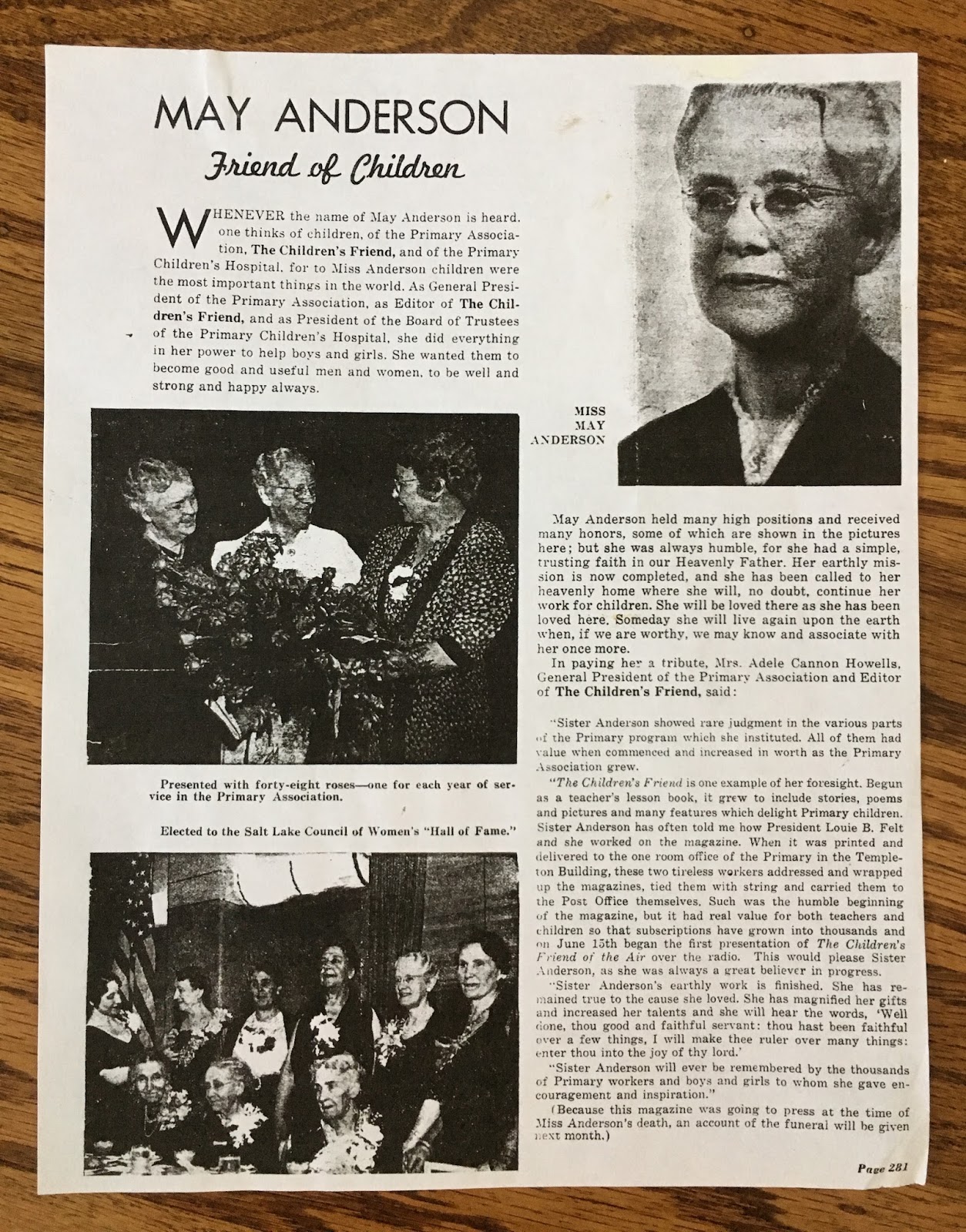
A smile came across his face and [he] put his arms around me and said there are six sons and three daughters. … Three daughters Elizabeth, May, and Kate. ... Then he asked me if I got the Children’s Friend [magazine], and I said the elders were very kind and have given it to me. Well, he said, have you seen a picture of a lady in there, May Anderson? Well, that is the daughter.”

May Anderson was a [first cousin once removed] to me.(11) She edited the magazine and also later
May Anderson, first cousin once removed
to Kate Findlay. Image Source
on she was the one proposed getting a children’s hospital and was in charge of the secretarial work in getting the money to build the hospital and I have the big bit with her picture that was in the paper after she died.(12)

He said she was a very good friend, and I’m going to write to her tonight. He gave me her address and asked me to write. She got my letter the same time she got his and I got a letter back and from then on it was a bit easier but I still had a lot of struggle to get this first start in genealogical work.

……….
Perhaps this is the same "big bit"/article that
Kate referred to. Grandma Ella shared this copy with KF.
Click to enlarge.
I wonder to what extent Kate Findlay and May Anderson then kept in touch. Unfortunately, May passed away in 1946, 2-3 years before the Findlays emigrated, so they never had the chance to meet in person.

But when the time came for Kate and daughter Ella to emigrate in May 1949(12), they were in contact with other American cousins from the Anderson family, also members of the church. As they crossed the US by train from New York to Salt Lake City, before they boarded a bus to Arizona, they were hosted for a few days in Salt Lake by Kate's second cousin: Louise Undine Loftus Anderson Clark. She was the daughter of Scott W. Anderson (May Anderson's brother) and Mary Ann Loftus.

In March of this year, I got in touch through Family Search with a grandson of Undine Clark: HC in Texas. I was curious to learn about how his branch of the Bruce line (his ancestors Mary Bruce and Scott Anderson from Shetland) had been introduced to the church and emigrated to Salt Lake City.(13) I was also wondering how Kate would have been in touch with these cousins across oceans and continents. At the time I was merely curious but hadn't yet received the Life History of George and Katherine Findlay (that would come in July), so I didn't know the details of Mrs. Jamieson in Leith first telling Kate of her American cousins.

Cousin HC replied in an email to me: I remember as a boy hearing her talk about the time her relatives came to see her on their way from Scotland to Arizona. I don't remember her saying they were LDS but she so loved seeing them she talked about it for years. That must have been your grandmother. Tell her Undine often talked lovingly about that visit from the "old country" to her grandchildren. She told me she made rack of lamb with mint jelly!

This past July, as we were in Utah on vacation, we visited the graves of Mary Bruce and Scott Anderson and their daughter May Anderson at the Salt Lake City Cemetery. I took a moment to tell them thanks - thanks for looking out for their cousins from the "old country" and  for helping to forever change the course of our lives.


Photos taken of the Anderson family graves in the
Salt Lake City Cemetery - July 2017
How is Kate Findlay related to these American cousins? See above.
Click to enlarge.

Also see these related posts:

Notes:
  1. Kate Findlay's full name was Ursula Katherine Bruce Findlay (pronounced ER-sill-a). Her mother was Ursilla Katherine Bruce Beattie (pronounced yer-SILL-a).
  2. If I’m understanding correctly, two Mormon missionaries knocked on Mrs. Jamieson’s door in Leith, having heard of Mrs. Jamieson's family and her bailiff father, and also wanting to get in touch with Kate's mother, Ursilla Katherine Bruce Beattie...Is that correct? Then, was one of those missionaries a cousin? Based on the timeframe, could that elder have been of the grandchildren of Mary Bruce and Scott Anderson?
  3. Elder William Sycivell Costley served in the British Mission from June 1929 to August 1931. Source: https://history.lds.org/missionary/individual/william-sycivell-costley-1910?lang=eng.
  4. Elder Carl Condie served in the British Mission from June 1930 to September 1932. Source: https://history.lds.org/missionary/individual/carl-condie-1909?lang=eng.
  5. Does anyone know who baptized and confirmed George? Does anyone have a copy of or the original baptismal certificate?
  6.  John A. Widtsoe was actually president of the British Mission just prior to this, from November 1927 to December 1928. Source: https://history.lds.org/missionary/individual/john-andreas-widtsoe-1872?lang=eng] James Henry Douglass, would have been the mission president at this time, who served from December 1931 to January 1935. Source: https://history.lds.org/missionary/individual/james-henry-douglas-1858?lang=eng]
  7. Is it clear which president this is referring to?
  8. I'm not sure what David O. McKay's church calling was in 1933 as he was previously president of the European Mission (1923-1925) and had not yet served as a counselor in the First Presidency (1934-1951) and this was years before he would be ordained President of the church (1951). However, he would have had the title of "president" in all of these positions. Source: https://en.wikipedia.org/wiki/David_O._McKay#Member_of_the_Quorum_of_the_Twelve
  9. Would this have been the mission president?
  10. I wonder whether Kate got the order of events slightly mixed up. Would she have first met Patriarch Wallis at the conference, when he asked her "What's troubling you?", and later given her the patriarchal blessing? As it's written, she received her blessing from Patriarch Wallis but then it sounds like they met for the first time afterward. It's a minor detail that does not affect the ending of the story.
  11. Kate Findlay had recorded that she was second cousins to May Anderson, but she was actually a first cousin once removed as Kate's mother, Ursilla Katherine Bruce was first cousins with May.
  12. May Anderson was the editor-in-chief of The Children’s Friend magazine from its inception in 1902, and she served as the first counselor to general Primary president Louie B. Felt from 1905 to 1925, then served as the second general president of the Primary from 1925-1939. Sources: https://history.lds.org/media/may-andersonlg?lang=eng#1; https://en.wikipedia.org/wiki/
  13. George had emigrated to the United States previously, in December 1948. Kate and younger daughter Ella followed in May 1949 while their older daughter Ina arrived in October 1949. 
  14. Cousin HC is working on compiling memories and information about his ancestors' conversion, Mary Bruce and Scott Anderson. As he prepares details, I hope to share relevant information on this blog. 

John McDonald and Ursilla Katherine Bruce Beattie - Final Resting Spot

On that windy, overcast morning in May, when we decided to visit the Allenvale Cemetery to find the unmarked(1) graves of Ella’s maternal grandparents, John McDonald Beattie and Ursilla Katherine Bruce Beattie (pronounced "Yer-SILL-a")(2), it seemed like it would be a fairly easy task, as we knew the cemetery section and plot number of the graves.(3) But as the events unfolded, it truly seemed that there was divine intervention to guide us in our efforts.

We had arrived in Aberdeen the afternoon on the previous day, and that evening at the hotel we met Ella’s first cousin CS for the first time.

After some introductions, she said that our visit had prompted her to revisit and sort through some documents that she inherited when her older sister had passed away. Included in these documents, which she unfolded so gently as some were quite delicate, were two hand-written receipts for Allenvale Cemetery, to George Findlay (Ella's father), dated 11 May 1936 and 8 February 1937.

Hand-written receipt to George Findlay for the payment
of a funeral plot at Allenvale Cemetery

In that moment, it didn’t make sense what those receipts would have been for. This was about 13 years before George and Kate Findlay (Ursula Katherine Bruce Beattie Findlay) and their family would emigrate and at that time they were just in their early 30s. Were they buying this plot to plan for their future?(4) We were planning on visiting that cemetery the next day, so we would do some further investigating while there.

The next morning, before we headed out for the day, I took another look at the receipts for the cemetery plots, and it hit me: The plot numbers listed there were for George Findlay’s in-laws, John McDonald and Ursilla Katherine Bruce Beattie. And the dates on the receipts were just days after they had both passed.(5) It now made sense: John and Ursilla had only one child, their daughter Kate, and thus after they passed, it would be Kate and her husband George who would provide for their burial.

……….

Allenvale Cemetery is such a beautiful cemetery, with tall trees and neat rows of headstones of various shapes and sizes. And it’s huge: it must have thousands and thousands of graves.

Allenvale Cemetery - thousands and thousands of graves!

We knew the grave location—section 2, lair/plot 278—but I was unable to find a cemetery map online, so we thought there might be some sort of sign or map at the cemetery itself. So we entered through the gates by Allenvale Road and Hardgate, and we walked in. Wow, was it overwhelming! With so many graves, how would we know where to begin?

The entrance to Allenvale Cemetery
off of Allenvale Road and Hardgate.
I ran ahead, looking for any plaques, maps, or markers, but I wasn’t  able to find anything. Instead, perhaps there might be an office, or a groundskeeper who could direct us?

After working my way through section after section of the cemetery, then across the street in yet another section, I saw a couple of chaps, and asked them whether they could help me find the plot. Sure! They were happy to help! They brushed their hands off on their overalls and apologized for the dirt - they were busy digging graves by hand that morning.

We entered into a small office on the side of a home in that part of the cemetery, and G, the energetic and friendly grave digger, pulled out a tattered map from a drawer. Wow, this office! It was not an “office” in the modern sense, but an unfinished room attached to a home, with a couple tables, perhaps a chair, and aged maps, barely being held together by threads, rolled up in the drawers. There was also a cabinet full of hand-written ledgers of burial records and loose papers, tucked onto the shelves. Nothing digitized - no wonder I couldn’t find this information online!

Confirming the location of the family plot.

Gathering around the map.

Hand-written ledgers of burial records.
G checked the map for the location I noted (section 2, lair/plot 278). The area we were interested in was right on a torn seam, so he was carefully rolling frayed pieces of the map down to try to piece it together. “Ah!” he says. “G. Findlay!” “Yes! That’s the one!” Why “G. Findlay” on the map? Because that’s who paid for the plot, even though he is not buried there. And because of the documents Cousin CS shared with us the night before, it was all making sense; there was no confusion about why G. Findlay’s name would be on the map.

"G. Findlay," located on that ripped seam.
Now that we had confirmed the general area, G grabbed the map and we headed out across the cemetery, with his fellow grave digger A following along.

We actually went back to the section of the cemetery near where we had parked our car and had initially walked in. We were so close already! G would energetically check the map, walk a few paces, check the map, get down on his hands and knees to check grave stones, removing his glasses, putting them back on, moving to the next spot with this ragged map billowing in the wind as he walked. Assuming that our family’s plot had no grave marker, we were checking the adjacent graves that had tomb stones, comparing them to the map. Our anticipation kept growing! We were on the verge of finding the plot!

Checking the map. So close now!
G and A thought they identified the spot, but there seemed to be another grave marker placed there - a loose one. As often happens, the stones might be moved for maintenance or groundskeeping work, and then erroneously placed back in the wrong spot. It appeared we had a squatter!

However, after closer inspection of the map, G confirmed that the grave we were looking for was right where we were standing, denoted by a small tin pot mostly submerged in the dirt (that perhaps held flowers at some time). We found it! What a thrilling treasure hunt! And how grateful we were for the help of these cheery grave diggers.


We were on the hunt! Found it!

The submerged tin pot in front of Ralph's left toe marks
the final resting place of John and Ursilla Beattie.


We lingered at the gravesite longer, marveling at the events of the day and so very grateful. Grandma Ella and I picked some of the tiny wildflowers that were growing in the lawn and laid a petite bouquet of wild daisies and dandelions on their graves.

A tiny bouquet, in remembrance.
……….

These are the graves of my great great grandparents, John McDonald Beattie and Ursilla Katherine Bruce Beattie. From what I’ve learned of them, life was not easy for them but they seem to have had strong characters. Both were deaf since childhood but that didn’t seem to hold them back. He was born in Aberdeen, an illegitimate child, his mother died when he was 9 and he grew up in an orphanage. She was born in Shetland. Her father died when she was 3 years old, and she spent 6 years at a boarding school for deaf students in Edinburgh. They married in their late 30s and had one child in their early 40s, whom they raised to be a strong, stalwart woman - Ursula Katherine Bruce Beattie Findlay (“Grandma Kate”), Ella’s mother. He worked in the Aberdeen iron foundry, dying of chronic bronchitis when he was 75. She was trained as a dressmaker and had worked for a time as a domestic servant as well. She died at age 74 of uterine cancer. Ella was just 2-3 when they died, so she doesn’t have any first-hand memories of them, though she heard much about them growing up.

……….

All coincidence perhaps, but I like to believe that the hand of God was helping orchestrate the day’s events, that through inspired thoughts and actions (including the receipts that Cousin CS shared and meeting the grave diggers), we were guided to answers, that so many little pieces and people came together to lead us to where our ancestors were laid to rest. Perhaps we would have found this information eventually regardless? But it all certainly came together in a way we couldn’t have anticipated.

What’s next? We are waiting to hear back from the burials office of Aberdeen City(6), as it’s time we have a proper gravestone marker put in place. “Until we meet again.”

……….


If you find yourself at Allenvale Cemetery in Aberdeen, Scotland, here are directions
for how to find the (currently) unmarked graves of John McDonald Beattie
and Ursilla Katherine Bruce Beattie.

……….
Notes:

  1. We weren’t 100 percent certain that the graves of John McDonald Beattie and Ursilla Katherine Bruce Beattie were unmarked, but we had vague memories of oral history recounting such.
  2. Ella’s maternal grandparents, John and Ursilla Beattie, passed away when Ella was 2-3 years old. I wonder whether Ella had ever visited the graves with her parents before they emigrated?
  3. The plot locations of John and Ursilla Beattie at Allenvale Cemetery were confirmed via email with a Bereavement Services Registrar at Marischal College on 5 Oct 2016.
  4. It also isn't apparent why George’s sister would have been the caretaker of these receipts, which were then passed to her daughters (eventually to Cousin CS), as these were for plots for George’s in-laws, not related to the Findlays. But for whatever reason, we were glad they were preserved!
  5. John McDonald Beattie: 12 November 1860 - 8 May 1936. Ursilla Katherine Bruce Beattie: 19 Feb 1862 - 6 Feb 1937.
  6. When I called Aberdeen City to inquire about getting a proper gravestone for their graves, they asked who had paid for the plot. Ah-hah! “I’ve got the receipts for that: George Findlay.”

John and Ursilla Beattie are Ella's
maternal grandparents.

Meet Ursilla Katherine Bruce Beattie (1862-1937)


Ursilla Katherine Bruce and
John McDonald Beattie
Ursilla Katherine Bruce (pronounced Yer-SILL-a, sometimes spelled as Ursula), daughter of Robert Bruce and Wilhilmina Inkster, was born in Burravoe on the Island of Yell, Shetland, on 19 Feb 1862. She was the 4th of their 6 children,(1) and was born at the Manor House, her family’s residence in Burravoe. She is Ella’s maternal grandmother.

Ursilla was deaf since childhood. Whether at birth or because of an accident or illness, we're unsure. The details from family oral history are not certain, but the family story goes that Ursilla was born healthy, but Robert came home drunk one night and kicked Ursilla’s cradle, permanently damaging the infant baby’s hearing. However, according to school admittance records when she was 8, she was born deaf, though wasn't completely so - she "evince[d] sensations from loud noises." We may never know what really happened!


The Manor House in Burravoe,
where Ursilla was born

Ursilla’s father Robert passed away when she was 3 years old (in 1865), and her mother remarried when Ursilla was 7 years old, to Duncan Campbell (1847 - bef 1896) in 1870.

From a Bruce Family Register: Ursilla Katherine Bruce was
born at Burravoe on 19 February 1862, and was baptized at 
Burravoe [date?] October 1862 by [?] James Barclay
(Click to Enlarge)


Sometime in 1870 (at age 8 1/2), Ursilla was admitted to the Donaldson’s School in West Coates, Edinburgh, a residential and day school for children who were deaf or had communication difficulties.(2) She lived here and attended school until 1876, about age 14, where students studied such subjects as English, writing, and arithmetic; assisted with sweeping schoolrooms and passageways; and started and ended each day in the chapel singing a psalm, listening to a passage from the Old and New Testaments, and ending in prayer. (3) Meanwhile, her mother Wilhilmina and stepfather Duncan were living in Lerwick on the main island of Shetland with her 3 living brothers (according to the 1871 census and the Donaldson's School admission registry.)

The former Donaldson's School, in West Coates, Edinburgh

Admission Register to Donaldson's School
for Ursula Katherine Bruce
(Click to Enlarge)


As of the 1881 census (at about age 18 or 19), Ursilla was back in Shetland, living with her mother at 1 Crooked Lane, Lerwick.(4) At the 1891 census, she and her mother were then next door at 3 Crooked Lane, Lerwick. She was aged 28 or 29 at that time.

Ursilla was trained as a dressmaker, and she also worked as domestic servant.(5)

On 15 June 1900, she married John McDonald Beattie in Edinburgh, at Hope Park Hall.(6) She was 37; he was 39. At some point after they were married, they settled in Aberdeen, John’s hometown. John was an ironworker by profession.(7)

John was deaf as well, and according to family oral history he become so when he was playing as a child, maybe about 9 years old Ella speculates, when he was accidentally knocked down or kicked. Ella remembers being told that her grandmother Ursilla never really learned how to speak, though her grandfather John could understand and talk somewhat, and could communicate better verbally. Both Ursilla and John would communicate with each other using sign language.

Ursilla with her only child, daughter
"Kate." Image Source: Life History of
George and Katherine Findlay
When Ursilla was 42 and John 43, they had their only child, Ursula Katherine Bruce Beattie (pronounced ER-sill-a, but she went by Kate), born at 35 Broomhill Road, Aberdeen, on 31 October 1904. This is Ella’s mother.(8)
Ursilla and John's home later in their lives:
Off of Bank Street, down this alley/close, on the
right, is this little cottage. Number 26 1/2 is on the
 top floor, the far right window.
- Sept 2006, Sept 2014.


Being an older couple, and having only one child, Ella imagines they were very protective of their daughter. In fact, Ella recounts a family story that sometime when Kate was about 4 years old, a doctor who made a housecall noticed that young Kate wasn’t talking yet, though she would communicate using sign language. “You’ve got to let this child out,” said the doctor, so that the child could be exposed to more language and learn to talk. Ella says that they reluctantly let her go and “she never had any trouble [after that.] She always had plenty to say!” She never forgot the sign language - Ella remembers seeing her mother use it to communicate with other deaf people in the community.


John and Ursilla Beattie

Ursilla and John apparently lived in several homes throughout their lives. Did they ever live in Edinburgh, which is why they were married there? Their daughter Kate was born at 35 Broomhill Road - can we assume she was born at home? According to the 1911 census, they were living at 274 Hardgate. And Ella remembers them living at 26 1/2 Bank Street, with her mother and father (George and Kate Findlay) living with them and her sister Ina being born there.

Ursilla passed away on 11 Feb 1937 at the home of her daughter Kate at 10A Prospect Terrace, Aberdeen, just 2 weeks shy of her 75th birthday. The cause of her death was "carcinoma of uterus," a type of uterine cancer.(9) She was survived by her daughter Kate and son-in-law George Findlay, and granddaughters Ina and Ella; her husband John had passed away the year before in 1936. She’s buried in Allenvale Cemetery in Aberdeen.(10)


Ella was only 3 years old when her grandmother Ursilla passed away, so she doesn’t have many memories of her, but remembers some details that her older sister Ina (who was 5 ½ years older) would share.

……….

If I could ask Ursilla any questions, what would they be? Oh, I’d start with asking about Shetland. She’s the last in a long line of ancestors that herald from there. Where did she live after her mother Wilhilmina died (in 1896; Ursilla was 34)? Did she ever go back after she was married (after 1900, at age 37)? Her mother and all of her siblings (five blood siblings and two half siblings) seem to have passed away by 1897. What was the relationship between her mother and the rest of her father Robert Bruce’s family, especially after Robert had died? Where did she receive her dressmaker training? Did she make her wedding dress? Where did she meet her husband John? Did she feel isolated not being able to communicate with most around her, or did she have the support of close friends (all of her immediate family had passed away; her husband John was an only child from an illegitimate father and an orphan from age 9 when his mother passed away, so no in-laws either)? What did she draw strength from? What made her smile?


26 1/2 Bank Street, Aberdeen - Filmed September 2014
(Note that in the video I kept saying 28 1/2 Bank Street. Doh!)
……….
Notes and Questions:

  1. Ursilla’s mother, Wilhilmina Inkster, had 2 additional children with 2 different fathers; Ursilla's father, Robert Bruce, had 13 children with 7 different women.
  2. More information about Donaldson’s School can be found here: https://en.wikipedia.org/wiki/Donaldson's_School
  3. Donaldson's School records are archived at the National Library of Scotland. I was able to able to request scans of relevant records. 
  4. Was her stepfather, Duncan Campbell living with them as well? He’s not listed on the census info on here after 1871? (Source: http://www.bayanne.info/Shetland/getperson.php?personID=I10400&tree=ID1) His death date is also unknown? Her younger half brother Alexander Campbell was listed as living with Ursilla and her mother in 1881. (Source: http://www.bayanne.info/Shetland/getperson.php?personID=I10401&tree=ID1)
  5. Source (under Notes): http://www.bayanne.info/Shetland/getperson.php?personID=I9215&tree=ID1. Where might she have received her dressmaker training?
  6. Source: http://www.bayanne.info/Shetland/getperson.php?personID=I9215&tree=ID1. Is this the same as what was renamed Queen's Hall in Edinburgh? (https://en.wikipedia.org/wiki/Queen's_Hall,_Edinburgh) Also mentions that they were “Married by W. J. Harwell, witnesses; Jane E. Bolt, William Low.” I wonder why they were married in Edinburgh? But first, how did they meet? Ella thought they might have met at Donaldson’s School, however, according to Donaldson’s records, there’s no record of him being a student there, nor at the other only deaf school in Edinburgh. In fact, according to this source http://www.bayanne.info/Shetland/getperson.php?personID=I145512&tree=ID1, he was placed in an orphanage at age 9, which would have been in 1869 or 1870, around the same time that Ursilla was at Donaldson’s. Additionally, they married while in their late 30s; does it make sense that they would have met as children and then married later? Which orphanage was he at? Are there records for this?
  7. John McDonald Beattie's profession as an ironworker is listed on several documents, including the 1911 census, the birth register for their daughter Ursula Katherine Bruce Beattie ("Kate"), and the marriage certificate for their daughter Ursula Katherine Bruce Beattie to their son-in-law George Findlay.
  8. Were Ursilla and John living at 35 Broomhill Road, and daughter Kate was born at home?
  9. See a scan of the death register, below.
  10. Burial place confirmed via email on 5 Oct 2016 by a Bereavement Services Registrar in the Bereavement Services Office, Marischal College, Aberdeen: Allenvale Cemetery, Section 2, Lair 278 (same as husband John).


Would love to find:

  • Orphanage records for John Beattie (in Aberdeen?)
  • Census records for Ursilla and John - for John before they got married then for both of them after they married (Found: 1911 Census, when Ursilla was 49, John 50, and daughter Ursula ("Kate") was 6.)
  • Marriage record for Ursilla and John
  • Trade guild/craft registry for ironworkers that would include John Beattie

……….

Ursilla is Ella's maternal grandmother


1911 Census - John MD. Beattie and Ursilla K. Beattie
(Click to Enlarge)


Death Register for Ursilla Katherine Beattie
(Click to Enlarge)